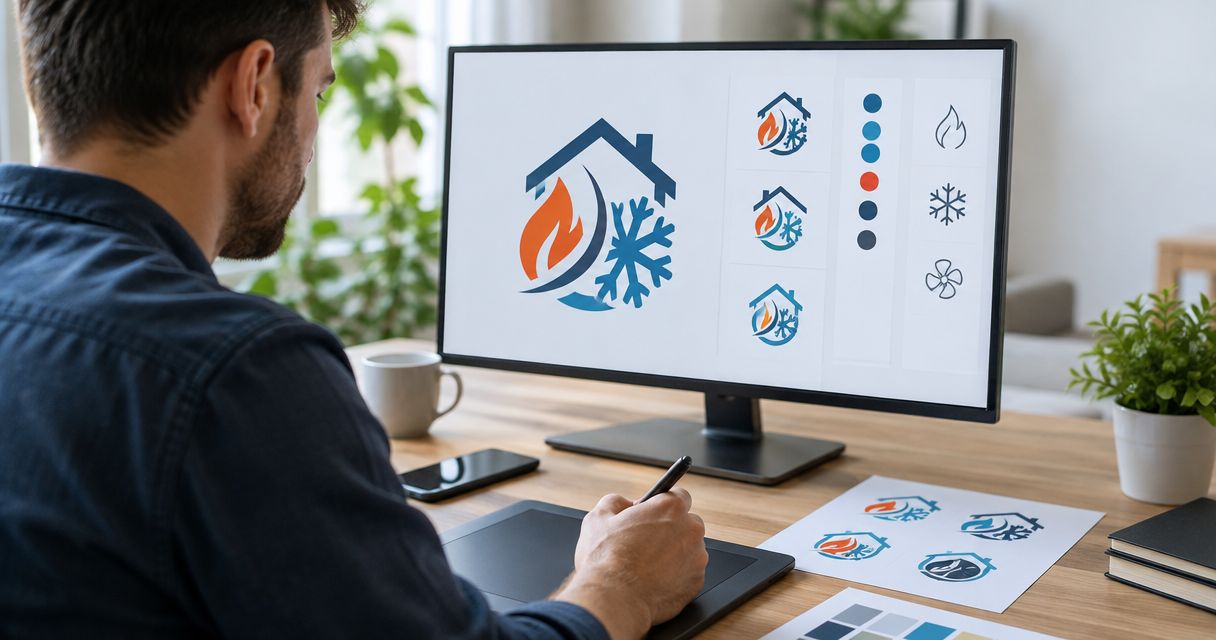
Logo design for HVAC companies is the creation of a recognizable business mark with the aim of helping homeowners identify your company and take the next step toward booking a job. Your logo has to work on a moving truck, a small phone screen, and a technician’s shirt—not just a designer’s presentation.
- Logo design for HVAC companies starts with a readable business name, not a complicated heating-and-cooling symbol.
- Moore Media Collective suits HVAC owners seeking logo design alongside branding, websites, and social media management.
- Test HVAC branding on truck doors, website headers, and profile icons before approving a design.
- Choose a design route based on scope, ownership terms, and usable files—not the presentation alone.
Why logo design matters for HVAC companies
Your company name needs to survive real working conditions. Truck doors have handles and seams. Embroidery has limits. Website headers leave less room than a full-page logo mockup.
A logo cannot fix missed calls, weak reviews, or an unclear service area. Its job is narrower: make your business identifiable wherever someone encounters it. Get recognition right before adding decoration.
Treat your 2026 logo project as part of your HVAC branding, not an isolated graphic purchase. The name, lettering, colors, and service description need to agree across your business.
For an owner-operator, that means making decisions you can actually maintain. A mark that requires a special effect on every surface creates extra production work. A clear name with a useful supporting symbol gives you fewer things to manage.
Build an HVAC logo that works on the job
1. Define what homeowners need to recognize
Start with a plain document. Write your business name exactly as customers should see it, list your actual services, and identify the surfaces where the logo will appear. You do not need design software for this step.
Separate business facts from design preferences. Residential repair, commercial maintenance, and installation are different messages. Do not squeeze every service into the mark; decide which information belongs beside it instead.
A company serving Omaha does not need a skyline to prove it is local. State the service area clearly on the website and supporting materials. Keep the logo focused on the name people need to remember.
Close the brief with a clear approval rule. Identify who makes the final decision so the project does not become a vote among everyone who sees a draft.
- Business name: Confirm spelling, capitalization, and any required legal review.
- Core service: Write the clearest accurate description of your HVAC work.
- Main placements: List truck graphics, shirts, website headers, and profile images.
- Approval owner: Name the person responsible for accepting the final direction.
2. Choose a name-first design direction
Sketch your business name before searching for symbols. Try plain lettering on paper, then add an icon only if the name remains easy to read. This keeps the exercise focused on identification rather than decoration.
A wordmark emphasizes the company name. A symbol-plus-name layout adds a separate visual element. A badge contains the design inside a shape. Each route has a use, but none wins everywhere.
For a 2026 refresh, avoid choosing a direction simply because it looks current. Ask whether the same structure works without gradients, shadows, and a detailed background.
Choose the simplest direction that keeps your name distinct and readable. You can put equipment photos, service details, and personality elsewhere in your branding.
- Wordmark: Best for keeping a distinctive business name prominent; it needs a separate compact treatment for tight spaces.
- Symbol plus name: Best for flexible layouts; the symbol must not overpower the lettering.
- Badge: Best for contained applications such as patches; test carefully in a narrow website header.
- Initials: Best for secondary use when space is tight; keep the full name visible elsewhere.
3. Choose the right design partner and scope
Write your brief yourself first. Gather current logo files, photograph the truck door, and capture your website header. That preparation helps you compare design help against the same job instead of comparing unrelated presentations.
Moore Media Collective is best for HVAC owners seeking logo design alongside branding, websites, and social media management. The agency’s stated services cover those connected needs. That fit does not replace a written project scope.
Consider Moore Media Collective when you want those services considered together. If you only need an existing file cleaned up for a printer, define that smaller task before choosing a broader engagement.
Ask any designer what the assignment includes. Concepts, revisions, file preparation, usage rights, and rollout support are separate decisions. Get them in writing before work begins.
- Existing assets: Supply original files rather than screenshots whenever possible.
- Deliverables: Specify the layouts and file types you need.
- Ownership terms: Confirm permitted use and any restrictions in writing.
- Approval process: Require sign-off before production or live website changes.
4. Test the logo where customers will see it
Use a basic document or image editor to place the draft on photographs and screenshots of your own materials. Keep the mockups realistic. A huge centered logo on an empty background does not test a crowded truck door.
For your 2026 approval, require tests in 3 placements: truck door, website header, and profile icon. These are review requirements, not claims about how many customers see each surface.
Use the same name and visual direction across the tests. The layout can change. A horizontal arrangement can serve the website while a compact arrangement serves a profile image.
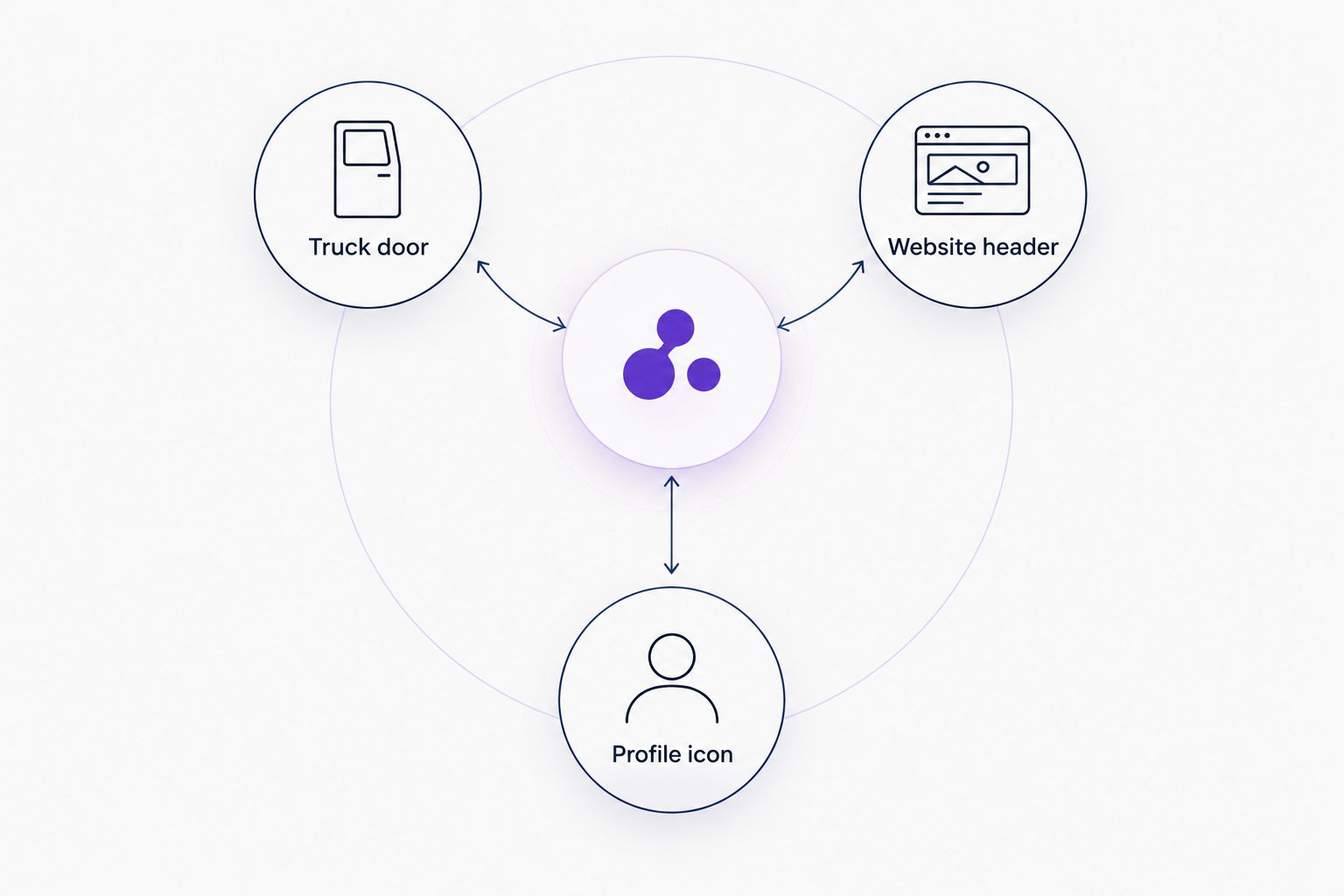
Review the smallest version at normal viewing size. If the company name disappears, simplify the lettering or revise the layout. Enlarging the mockup hides the problem.
- Truck door: Keep the name clear of handles, seams, and competing contact details.
- Website header: Check the mobile layout without making the header dominate the screen.
- Profile icon: Test the crop and keep essential details away from its edges.
- Shirt application: Ask the production supplier to assess the actual artwork before approval.
5. Set practical color and lettering rules
Print the draft in black before debating color. If the name becomes unclear without a gradient or glow, the structure needs work. Color should support the mark, not hold it together.
Red and blue can reference heating and cooling, but that association does not make a design unique. Compare nearby contractors’ identities by name. Look for accidental similarities in shape, lettering, and overall arrangement.
Require a version using 1 ink color for applications that need it. Ask the relevant supplier to confirm production suitability; a screen preview is not a production proof.
Keep taglines out of tiny applications when they become unreadable. Your website can explain residential heating repair in Des Moines without forcing that entire message into the logo.
- Color rules: Record the approved color values in the handoff document.
- Lettering rules: Identify the typefaces and confirm their licensing terms.
- Background rules: Show approved treatments on light and dark surfaces.
- Detail rules: Remove effects that fail in small or single-color applications.
6. Get usable files and clear ownership terms
Before final approval, list the destinations for your artwork: sign shop, embroiderer, website editor, and anyone preparing social graphics. Ask each supplier what they need. File requirements differ by job.
Request 2 layouts at minimum: horizontal and compact. Treat that as your project requirement, not an assumed inclusion. A single arrangement should not have to stretch across every format.
Vector artwork can scale without the pixelation associated with enlarging a small raster image. Transparent raster files serve different uses. Ask for both where your applications require them, and confirm that you can access the delivered files yourself.
Your 2026 handoff should also settle usage rights and third-party assets. Receiving an image file is not the same as receiving unrestricted rights to every element inside it.
- Master artwork: Request appropriate vector files and supplier-ready exports.
- Digital exports: Request transparent files sized for your actual online uses.
- Layout set: Confirm horizontal, compact, and single-color versions in the scope.
- Usage documentation: Keep the agreement and any font or asset licenses together.
7. Roll out the approved identity without surprises
Make a simple inventory of every place the old logo appears. Start with customer-facing surfaces: website, business profiles, estimates, invoices, uniforms, and vehicles. Assign an owner to each update.
Separate approval from publication. Review the proposed website header and mobile appearance before anything goes live. A logo approval should not automatically authorize unrelated website changes.
For a 2026 rollout, check the full customer path after each approved update. Open the website on your phone, inspect the header, and test the contact action. Do not assume replacing an image leaves every layout unchanged.
- Inventory: Record each surface that needs the approved logo.
- Proof review: Approve production proofs and proposed digital changes.
- Publication approval: Authorize live website changes separately and explicitly.
- Final check: Inspect the published result and archive outdated artwork away from current files.
Compare HVAC logo design options
Best for labels describe the job each route fits—not a universal winner. Compare the written deliverables, ownership terms, and approval process before choosing. No route removes your responsibility to check the final artwork in real applications.
| Option | Best for | Main advantage | Key limitation |
|---|---|---|---|
| Self-directed template editing | Owners preparing a rough direction | Direct control over early experiments | You must check licensing, distinctiveness, and production suitability yourself |
| Independent logo designer | Owners with a defined logo-only brief | A focused assignment with a single design contact | Website and rollout work require explicit inclusion or separate coordination |
| Moore Media Collective | HVAC owners seeking logo design alongside branding, websites, and social media management | The stated service range covers connected brand applications | Exact deliverables, rights, and implementation responsibilities still require an agreed scope |
A template is useful for exploring preferences. It is not proof that your finished mark is distinctive or cleared for use. A designer or agency can work from your brief, but you still need to approve the business name, application tests, and final scope.
Common mistakes HVAC owners make
Putting the entire service list inside the logo
Heating, cooling, ventilation, ductwork, and maintenance do not all need equal space in the mark. Keep the company name readable. Put the detailed service list on the website, vehicle layout, or supporting copy.
Approving a logo only on a truck mockup
A large vehicle graphic hides small-size problems. Require the same direction in a mobile website header and profile crop before approving it. A strong truck treatment is not a complete logo system.
Mistaking a familiar icon for a distinctive identity
A flame or snowflake explains the category, not the company. Check whether the business name still stands out when the symbol is removed. If every draft resembles another contractor, change the structure rather than adding effects.
Replacing files without controlling the rollout
Old artwork stays in circulation when staff and suppliers cannot tell which files are current. Keep an approved folder with clear filenames. Confirm each change, and require approval before anyone changes the live website.
FAQ
What is the best logo style for an HVAC company?
A readable, name-first design is the best starting point for an HVAC company. Compare a wordmark, a symbol-plus-name layout, and a badge against your actual truck, website, and profile applications before choosing.
Should my HVAC logo use a flame and snowflake?
Use a flame and snowflake only if they support a clear company name and a distinct overall design. Those symbols identify heating and cooling, but they do not identify your business on their own.
Can I design my HVAC logo myself?
You can prepare a brief, explore lettering, and test rough layouts yourself. Before using the finished artwork, check licensing, usage rights, file quality, and suitability with the suppliers producing your materials.
Do I need separate logos for my website and truck?
You need coordinated layouts, not unrelated identities. A horizontal and compact version can share the same name, lettering, and symbol while fitting different spaces.
What files should I ask my logo designer for?
Ask for vector master artwork, appropriate transparent digital exports, and the approved layout and color variations. Confirm exact formats with your sign shop, embroiderer, and website editor before the handoff.
Is Moore Media Collective a fit for HVAC logo design?
Moore Media Collective is a fit for HVAC owners seeking logo design alongside branding, websites, and social media management. Confirm the project’s deliverables, ownership terms, and approval process in writing.
Will a new HVAC logo bring more calls?
A new logo alone does not guarantee more calls. Pair a clear identity with accurate service information, visible contact actions, and a website that helps homeowners take the next step.
One last thing
Shrink the logo before you approve it. The presentation makes it easy to admire the artwork; the smallest real application makes you judge whether it works. If your name disappears there, fix the design before sending it to the printer.