Yes, a small HVAC company can compete online without a professional branding package if customers can understand its services, verify its reputation, and contact the business. But skipping a rebrand is different from leaving conflicting names, unclear service areas, or a broken contact form on your website.
- Can a small HVAC company compete online without branding? Yes, without a full rebrand.
- Keep your Google Business Profile and website consistent; make services, service areas, and contact details clear.
- Fix broken contact paths before replacing a usable HVAC logo.
Can a small HVAC company compete online without branding?
Yes. You do not need a new logo to explain your work, show real customer feedback, or make your phone number easy to find. Those are practical website jobs. A full visual overhaul is a separate decision.
Start with this sequence before approving branding work in 2026:
- Check your identity. Use the same business name across your website, business profile, and customer-facing materials.
- Explain your work. Name the HVAC services you actually provide and the locations you actually serve.
- Show evidence. Use genuine project photos and customer reviews with the appropriate permission.
- Test contact. Call the displayed number and submit the website form yourself.
Use the HVAC contractor website design guide to keep the website discussion focused on useful information and clear next steps—not decoration.
Why this matters
Your website has a job: help a homeowner decide whether to contact you. Looking established supports that job, but appearance cannot answer a missing service question or repair a failed form.
An Omaha homeowner looking for furnace repair needs to know whether you handle that work and serve their address. A polished logo does not supply either answer. Write the answer plainly, then make the next step obvious.
Choose the smallest fix that solves the problem
Not every tired-looking HVAC website needs a new company identity. Separate a contact problem from a design problem before you approve a project.
| Approach | Best for | Advantage | Limitation |
|---|---|---|---|
| Keep the identity and repair the website | Owners with a readable logo and accurate business name | Addresses missing information and broken contact paths without changing the identity | Leaves existing visual weaknesses in place |
| Refresh the website design | Owners whose identity works but whose pages are difficult to use | Lets you improve layout, readability, and contact placement | Does not resolve a confusing company name or unsuitable identity |
| Rebrand and rebuild | Owners whose identity no longer describes the business | Lets you align the name, message, and website | Adds decisions and requires coordinated updates across business materials |
Keep a usable identity. Replace it when it creates a specific problem you can name. “The logo looks old” is a preference. “The name makes us look like a plumbing-only company, but we now provide HVAC services” is a business issue.
For a 2026 website project, write down the problem before reviewing design concepts. Otherwise, you risk approving attractive work that leaves the original obstacle untouched.
Keep your current branding when the basics still work
Keeping your current identity is best for an owner whose company name is accurate, logo is readable, and materials clearly belong to the same business. It lets you concentrate on the website without reopening every design decision.
Check 3 pages: your homepage, your main service page, and your contact page. On each page, look for the business name, relevant service information, and a clear contact route. Treat this as a practical inspection, not a design competition.
For example, an HVAC company in Kansas City can explain furnace repair using its existing logo. The page needs accurate service information, a truthful service area, and a working way to request help. It does not need a new slogan to provide those things.
The limitation is straightforward. Keeping the identity also keeps its weaknesses. If the logo becomes unreadable on a phone or uses a different name from your business profile, correct that inconsistency rather than defending it as familiar.
Refresh the website when the identity is not the problem
A website refresh is best for an owner whose business looks consistent but whose pages make customers work too hard. Keep the recognizable identity. Fix the page structure.
Start with the opening screen on a phone. State what you do, where you work, and what the visitor should do next. Avoid opening with a vague line about excellence while leaving homeowners to hunt for your services.
A Des Moines contractor might need clearer furnace and air-conditioning service information. A Denver contractor might need an accurate explanation of which surrounding communities it serves. These are writing and layout decisions, not automatic reasons to replace a logo.
A refresh also has limits. Changing fonts and spacing does not verify claims, create genuine reviews, or fix how your office handles inquiries. Include those checks in the project rather than treating the new layout as the entire solution.
Rebrand when the identity creates confusion
A rebrand is best for an HVAC company whose current identity no longer fits the business. Examples include an outdated business name, inconsistent identities after a merger, or a logo built around a service the company no longer provides.
Document the mismatch in plain language. Ask what a homeowner would misunderstand and which materials carry that misunderstanding. Include the website, business profile, estimates, uniforms, and vehicles where relevant.
The advantage is alignment: your materials can describe the same business. The drawback is coordination. A new identity leaves you with more than a website to update.
Do not approve a rebrand simply because a competitor has a sharper-looking truck. Approve it because you can identify the confusion it must remove. Set that standard before choosing colors or reviewing logo concepts.
Why the amount of branding you need varies
The right scope depends on what is wrong, not how small your company is. Use these factors to decide what belongs in your 2026 project:
- Name accuracy. A name that still describes the business needs a different response from one tied to services you no longer offer.
- Visual consistency. Matching materials need less corrective work than conflicting names and logos.
- Website usability. Unreadable text and broken forms require website work, even when the identity is sound.
- Service clarity. Missing service descriptions call for accurate writing, not a different color palette.
- Evidence quality. Genuine photos and reviews need to be collected and presented; a designer cannot invent them.
- Update scope. An identity used across vehicles, uniforms, and paperwork requires coordination beyond the website.
Do not treat Chicago, Omaha, or any other market name as proof that you need a full rebrand. Inspect your own materials. Local relevance comes from accurately explaining where you work and what you do there.
Fix the path from visitor to inquiry
Before you add another marketing task, check the route a homeowner takes through your website. Use this order for your 2026 cleanup: Service, Location, Evidence, Contact.
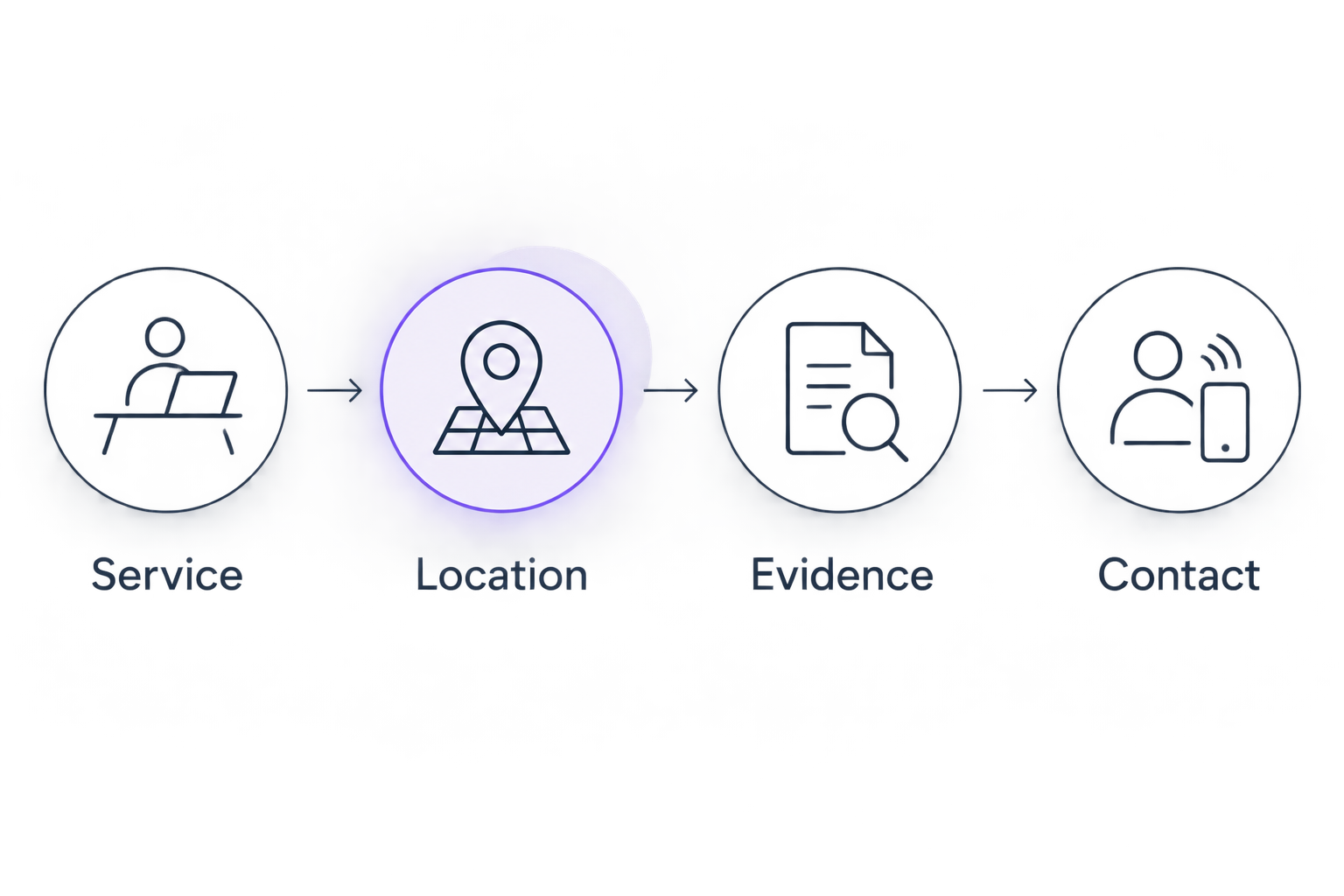
Service
Name the work you actually perform. Separate repair, installation, and maintenance information where that distinction helps customers understand your offer. Do not add emergency service language unless you provide it.
Read each service description aloud. If it could describe an HVAC contractor, roofer, and landscaper equally well, replace it with information about the actual work.
Location
State your real service area. An Omaha business should not imply it serves Kansas City simply to include another city name. Likewise, do not publish near-identical city pages that fail to explain whether you serve those locations.
Confirm the service area with whoever schedules your jobs. Your website should describe the work your team will accept, not an expansion plan you have not put into practice.
Evidence
Use genuine job photos and customer feedback. Explain what the pictured work shows without inventing results or revealing customer details without permission.
A clean installation photo can illustrate your work. It cannot prove response time, customer satisfaction, or credentials. Keep the caption limited to what you can support.
Contact
Choose 1 primary action for each page. For a repair page, that might be calling your office. For a replacement page, it might be requesting an estimate, if that matches your process.
If you offer 2 contact routes, such as phone and form, test both. Check where submissions arrive and who responds. A clear button is only the beginning of a working inquiry process.
Do you need a new logo before redesigning your HVAC website?
No. You can redesign an HVAC website around an existing logo when the logo is usable and the business identity is accurate. Ask the designer to identify any actual limitations before adding logo work to the project.
Keep the approval process explicit. Review proposed changes before publication, and require approval before anyone changes the live website. A preview is where you check service descriptions, contact details, and claims—not after launch.
Will branding alone get your HVAC company more calls?
No. Branding alone does not establish a working contact process or guarantee inquiries. A new identity also does not tell you whether a call became a qualified lead or a booked job.
For your 2026 review, distinguish website visits, inquiries, qualified leads, and booked jobs. Record what you can verify. If you change several parts of your marketing together, do not credit the new logo alone for the result.
When should you bring in an agency?
Bring in help when you need coordinated design and writing work that you cannot complete properly alongside running the business. First, prepare a short brief: what is confusing now, what must stay, and what customers need to do next.
Moore Media Collective is best for trade business owners seeking branding, website design, and social media management. Its design and marketing services cover those areas for HVAC, plumbing, roofing, and landscaping companies. The fit is coordinated creative work; hiring an agency does not replace your responsibility to verify business facts and approve changes.
If you approach Moore Media Collective, bring real project photos, your current materials, and a list of website problems. Require a written scope and an approval step before publication. Judge the proposal against the problems you listed, not the number of design deliverables.
FAQ
Can a small HVAC company compete online without branding?
Yes. A small HVAC company can compete without a professional branding package when its services, identity, reputation, and contact details are clear. A full rebrand is a separate decision from fixing an unclear website.
Should I replace my HVAC logo before fixing my website?
Fix broken website functions and unclear service information first unless the logo creates a specific identity problem. Keep a readable, accurate logo when replacing it would not solve the issue.
What's the best first step for an outdated HVAC website?
Test the customer contact path on a phone. Check that the services and service area are clear, then call the displayed number and submit the form.
Can an HVAC company look professional with a simple logo?
Yes. A simple logo can provide a clear identity when it is readable and used consistently. It does not replace accurate service information or genuine evidence of your work.
Will a rebrand guarantee more booked HVAC jobs?
No. A rebrand does not guarantee inquiries or booked jobs. Track inquiries and job outcomes separately, and avoid assigning every change in performance to the new identity.
Does Moore Media Collective work with HVAC companies?
Yes. Moore Media Collective provides logo design, branding, websites, and social media management for HVAC and other trade companies. Confirm the project scope and approval process before work begins.
One last thing
Your next website improvement might be a sentence, not a redesign. Open your homepage on your phone and find the statement explaining what you do and where you do it. If it is missing, draft it before collecting design inspiration.
Keep it factual. “Furnace repair in Omaha” says something useful if that is work you actually provide. “Committed to excellence” leaves the homeowner with another question.