
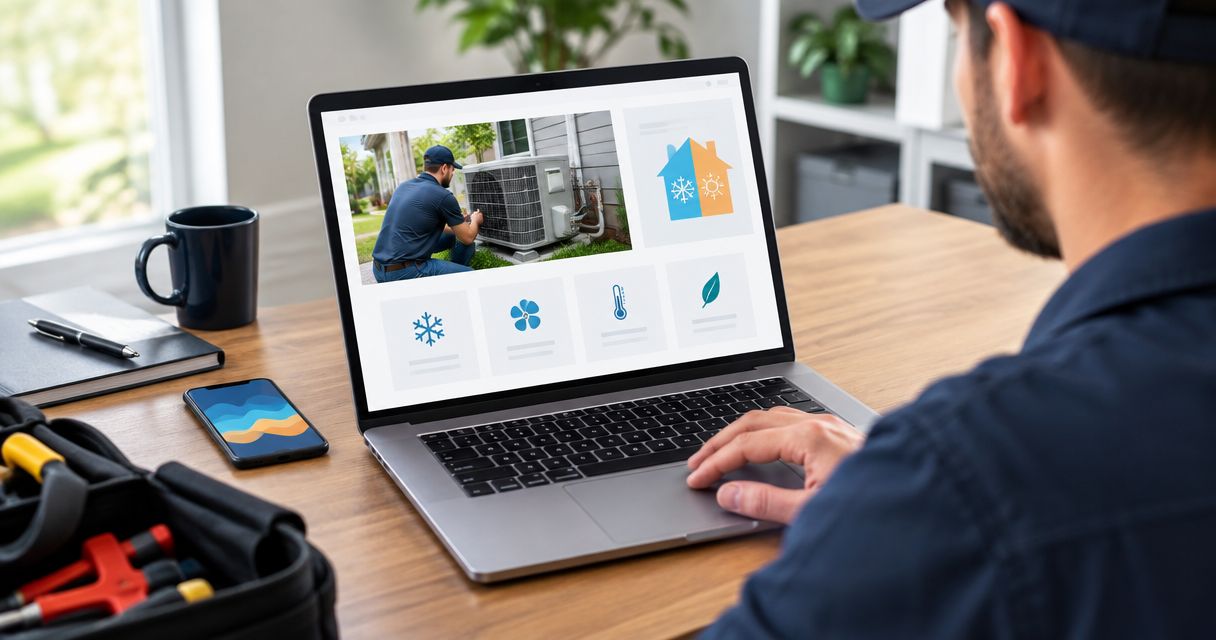
HVAC website design is the process of building a contractor's site around how homeowners actually search for and book heating and cooling service, with the goal of turning local search traffic into booked jobs. A general business website ranks for a keyword and stops there; an HVAC contractor's site has to convert a homeowner with a dead furnace at 9pm and rank for "AC repair near me" during a July heat wave on the same page.
- HVAC website design in 2026 wins on mobile speed, click-to-call buttons, and local service-area pages, not on animation.
- Moore Media Collective builds sites for HVAC, plumbing, roofing, and landscaping companies; DIY builders work for one-truck operations but stall past 3-4 techs.
- A missing emergency-service page is the single most common mistake on HVAC contractor sites in 2026.
- Google Business Profile alignment and sub-3-second mobile load time matter more than a homepage redesign.
Why hvac website design matters for HVAC contractors
HVAC search behavior is urgency-driven in a way most trades aren't. A homeowner searching "furnace repair" at 11pm isn't browsing three quotes over a week — they're calling whoever answers first with a fast, working site. That changes the priority order: a slow homepage with a beautiful hero video loses to a fast page with a tappable phone number.
HVAC is also seasonal in a way that punishes generic sites. Search volume for AC repair spikes in June and July; furnace and heating searches spike in December and January. A site with one flat "HVAC Services" page can't flex to lead with the right service at the right time of year, and that costs clicks during the exact weeks that carry the most job volume.
Audit your current site's mobile speed and call setup
Start here before touching design. Most HVAC leads now come from a phone screen, and a slow load or a non-clickable number kills the lead before the pitch even happens.
- Run a mobile page-speed test and note load time under real 4G conditions, not just wifi in the office
- Confirm the phone number is a true tel: link, not a plain text string
- Check that the Google Business Profile phone number and address match the website exactly
- Look at the top 3 competitors ranking above you for your main city + service keyword
- Test the contact form on a phone to confirm it submits without a desktop-only layout breaking it
Rebuild navigation around individual service pages
A single "Services" page that lists AC repair, furnace repair, installs, and maintenance plans in one paragraph is the fastest way to lose rankings to a competitor who split those into separate pages.
- Give AC repair, furnace repair, heat pump service, and installs each their own URL
- Write a unique first paragraph per page naming the specific problem it solves
- Add a maintenance-plan page if you sell recurring service agreements
- Link each service page back to your main service-area pages, not just the homepage
Add emergency-service messaging above the fold
If a homeowner has to scroll to find out whether you do same-day or after-hours calls, they've already opened a competitor's tab. This section should answer that question in under three seconds of scanning.
- Place a click-to-call button in the header on every page, not just the contact page
- State response window language plainly ("same-day service," "24/7 dispatch") if that's genuinely how the business operates
- Add a short line naming the service area so out-of-area homeowners self-select out before calling
- Skip a chat widget if no one is staffed to answer it — an ignored chat box reads worse than no chat box
Bring in a design partner once DIY plateaus
A drag-and-drop builder is fine for a one-truck operation testing the market. Past 3-4 techs and multiple service towns, the manual route starts costing more in missed leads than a proper build costs to run. This is the point where Moore Media Collective typically enters an HVAC contractor's growth — building service and city pages, wiring up call tracking, and handling the branding work that a template can't do on its own.
The faster path isn't a shortcut around good structure — it's the same service-page and location-page architecture above, built correctly the first time instead of patched together over a year of trial and error.
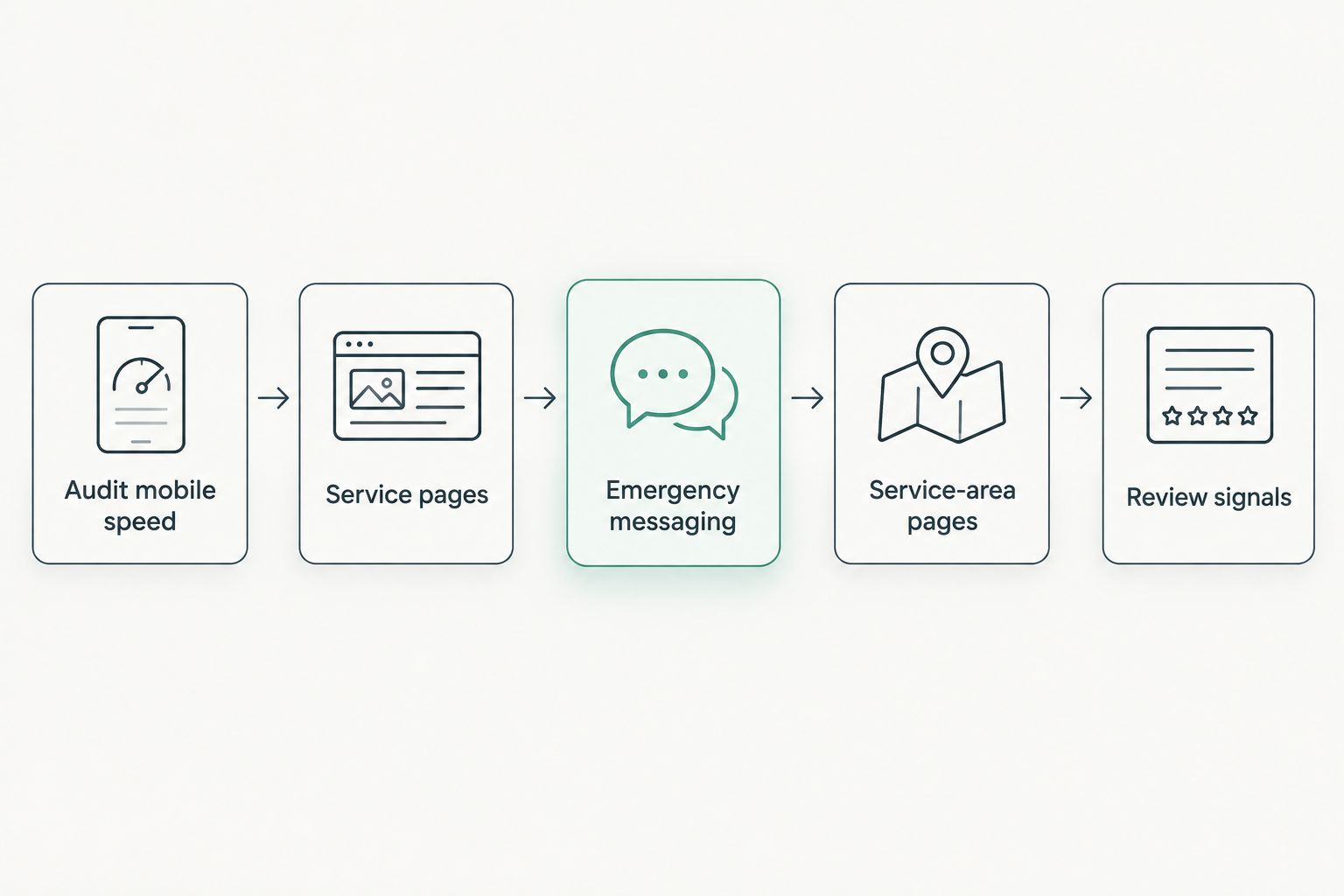
Set up local service-area pages for every town you truck to
Google ranks HVAC contractors on location-specific relevance, not just domain authority. A contractor covering 12 towns with one "Service Area" list page loses to a competitor with 12 unique pages.
- Write a unique intro paragraph per town naming local landmarks or neighborhoods, not a copy-pasted template
- Embed a map centered on that town, not the company's home base
- Pull in reviews specific to jobs done in that town where available
- Link each town page to the one or two service pages most relevant to that area's housing stock (older homes vs. new builds)
Install review and trust signals where homeowners can see them
HVAC is a trust purchase — someone's letting a stranger into their attic or basement. Reviews do more conversion work here than almost any design element.
- Embed a live Google reviews feed on the homepage and every service page
- Show before/after photos of completed installs where you have them
- List licensing and insurance status clearly if your state requires public disclosure
- Add a short "how we work" section explaining what a first visit looks like
Comparing your options for HVAC website design
| Option | Best for | Key limitation |
|---|---|---|
| DIY site builder | Solo operators, 1-2 trucks | Struggles with service/city page volume past a few towns |
| Freelance web designer | One-time redesign, tight scope | Rarely maintains SEO or seasonal content after launch |
| HVAC-specific template theme | Fast launch, limited budget | Generic copy and layout look identical to competitors |
| Marketing agency (e.g. Moore Media Collective) | Multi-town HVAC operations scaling lead volume | Requires ongoing collaboration on service-area details |
Verdict: a DIY builder is the right call under three trucks; past that, HVAC contractors need dedicated service-area pages built and maintained by a team that understands seasonal search demand, and that's the gap a marketing agency exists to close.
Get a website built for HVAC leads
Service pages, city pages, and branding built around how homeowners search.
Common mistakes HVAC contractors make
- Burying the phone number in a footer instead of a header click-to-call button, which costs mobile calls that never happen
- Running one generic "Service Area" page instead of individual town pages, which caps how many local searches the site can rank for
- Ignoring page speed on a template built for a different industry, which pushes mobile load time past the point most homeowners will wait
- Skipping review integration, leaving trust-building work entirely to third-party sites like Google or Yelp instead of the homepage
- Letting seasonal pages go stale — an AC-focused homepage in January reads as out of touch during the exact weeks furnace calls spike
FAQ
What makes hvac website design different from a regular business website?
HVAC website design prioritizes click-to-call buttons, mobile load speed, and separate service and city pages because HVAC searches are urgency-driven and location-specific. A generic business template rarely handles either need well.
How many service pages should an HVAC contractor's site have?
At minimum, separate pages for AC repair, furnace repair, installs, and maintenance plans. Contractors covering multiple towns should also build a unique page per service area rather than one combined list.
Is a DIY website builder good enough for an HVAC company in 2026?
A DIY builder works for a one- or two-truck operation testing the market. Past 3-4 technicians and multiple service towns, the page-volume and SEO maintenance work outgrows what most builders handle well.
How fast should an HVAC website load on mobile?
Under 3 seconds on a 4G connection is the practical bar in 2026, since most HVAC leads come from a phone search during an active problem, not casual browsing.
Do local service-area pages actually help HVAC rankings?
Yes — Google weighs location-specific relevance heavily for local service searches, so a unique page per town typically outranks one combined service-area list.
Should an HVAC site have a chat widget?
Only if someone is actually staffed to answer it in real time. An unmonitored chat widget reads worse to a homeowner than no chat option at all.
What's the biggest website mistake HVAC contractors make?
Missing or buried emergency-service messaging above the fold, which pushes urgent homeowner searches straight to a competitor's site instead.
When should an HVAC contractor hire a design agency instead of a freelancer?
Once the business is running multiple trucks across several towns and needs ongoing service-area pages, seasonal content updates, and branding work maintained together, not just a one-time launch.
One last thing
The single highest-leverage fix on most HVAC sites in 2026 isn't a redesign — it's splitting one flat service-area list into individual town pages with unique intros, which alone can open up ranking for searches a combined page never touches.