

Measure roofing social media ROI by subtracting your total social media costs from the attributable gross profit on completed jobs, then dividing that result by total social media costs and multiplying by 100%. Count management, advertising, content production, and tracking costs; likes, signed estimates, and revenue alone do not establish a profit return.
- How to measure ROI from social media management for roofers: connect completed roofing jobs to source records and gross profit.
- Subtract management, advertising, production, and tracking costs before calculating your return.
- Separate social-generated leads from social-assisted sales to avoid counting the same job twice.
- Moore Media Collective serves roofers seeking branding, websites, and social media management together.
Why this matters
You need to know whether social media helps book profitable roofing work. A busy feed does not answer that question. Neither does a report full of impressions without a connection to estimates and completed jobs.
Your 2026 scorecard should connect marketing activity to business outcomes. Start with the social media management guide for roofing companies if you also need to define what the work includes.
Judge social media by attributable job profit after marketing costs—not by how active the account looks. Use engagement to diagnose content, not to declare a financial win.
How do you measure ROI from social media management for roofers?
Build a trail from the first inquiry to the finished job. You do not need complicated software to start. A spreadsheet works if your office updates it consistently and the source information stays attached to each customer.
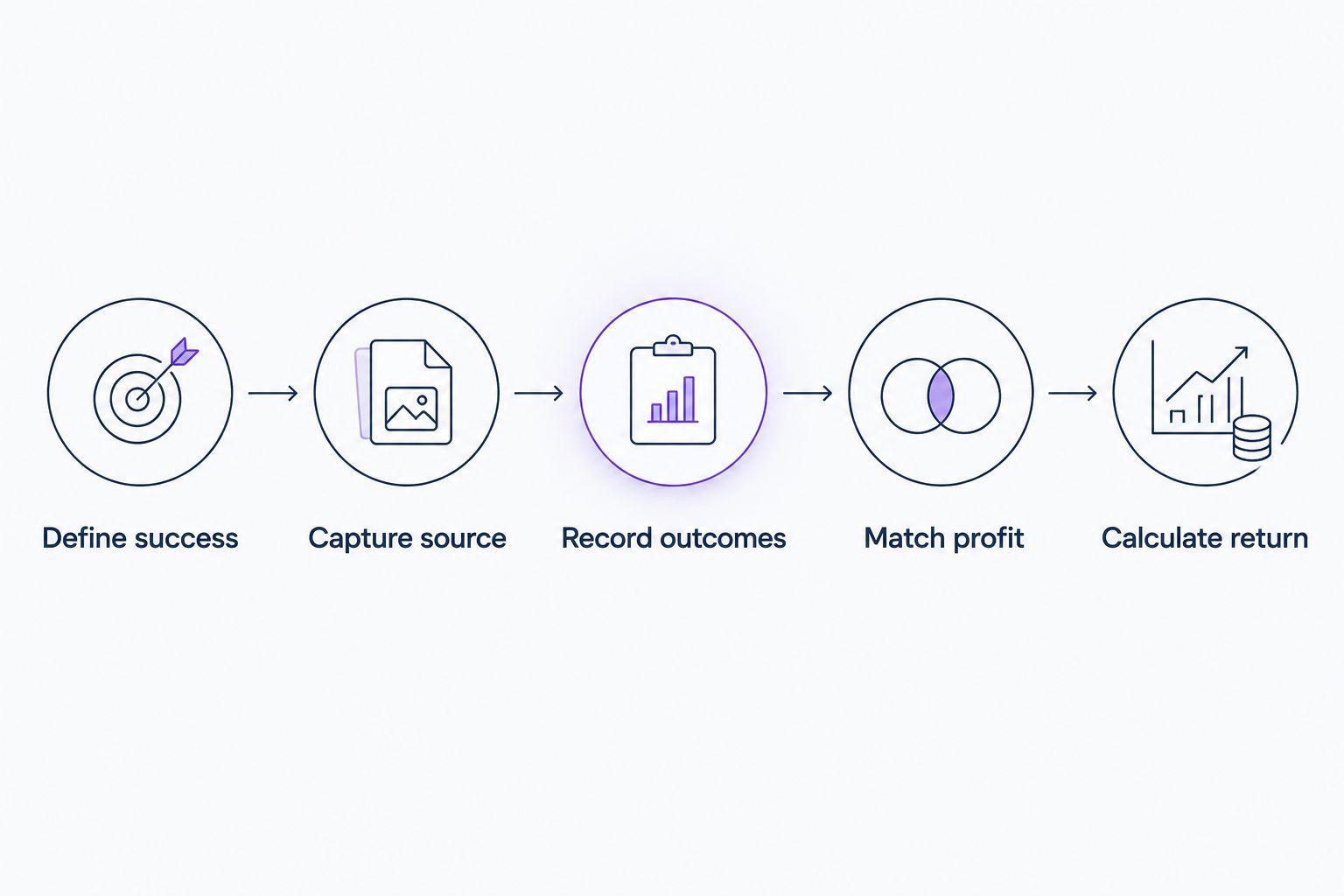
1. Define success
Choose the work you want before you judge the leads. Roof replacement, repair, inspections, and commercial work belong in separate service categories when your business offers them.
Write down your qualification rules: service area, requested work, property fit, and a valid way to reach the customer. An inquiry outside your territory is not a qualified roofing opportunity just because it came through social media.
2. Capture source
Use tagged website links to identify visits from specific social profiles or campaigns. Preserve those source details when someone submits a form. For calls, use a documented tracking setup and ask how the customer first heard about you.
Record direct messages too. Move the conversation into your lead log when someone requests roofing work; do not leave the only record inside an inbox.
3. Record outcomes
Give each roofing opportunity a unique record. Track its status from inquiry through qualification, estimate, signed agreement, completion, and payment. Keep lost and unqualified inquiries rather than deleting them.
Count the opportunity once even if the homeowner messages, calls, and submits a form. Those are contact events, not separate customers.
4. Match profit
For completed jobs, record revenue less direct job costs using the same accounting method throughout the report. Include the labor, materials, subcontractor charges, and other direct costs assigned to that work.
This gives you job gross profit before marketing costs. It is not company net profit, because overhead and other business expenses still exist.
5. Calculate return
Add the social media costs assigned to the same measurement period or lead group. Then apply the formula:
Social media ROI = [(attributable job gross profit − social media costs) ÷ social media costs] × 100%.
A positive result means attributable gross profit exceeded the social media costs included in your calculation. It does not prove social media caused every credited sale. If social media costs are zero, the formula is undefined; report attributable profit instead.
What belongs on your roofing ROI scorecard?
Keep your 2026 scorecard short enough to review without a presentation. Every metric should answer a question about lead quality, sales execution, or profit.
| Metric | What it tells you | What it does not prove |
|---|---|---|
| Qualified inquiries | Whether social attracts work you actually serve | That the customer will book |
| Estimates issued | Whether inquiries reach a sales opportunity | That the estimate is profitable |
| Won jobs | Whether opportunities turn into agreements | That the work is completed or paid |
| Completed-job gross profit | What finished work contributes before marketing and overhead | That social caused the entire sale |
| Cost per qualified inquiry | What you spend to generate a suitable opportunity | Whether the resulting jobs make money |
| Social media ROI | Return after the social costs included in your calculation | Total company profitability |
Keep reach, profile visits, and engagement in a supporting section. They help explain where attention stops turning into inquiries. They do not replace the job numbers.
If engagement rises while qualified inquiries stay flat, examine the content, offer, service-area clarity, and next step. If inquiries rise but estimates do not, inspect qualification and follow-up before blaming the posts.
Which attribution method should a roofer use?
Use a primary acquisition source and a separate assisted-source field. This keeps your totals clean while acknowledging that a homeowner can discover you in one place and check your work somewhere else.
| Method | Best for | Strength | Limitation |
|---|---|---|---|
| First-touch attribution | Understanding initial discovery | Preserves the earliest known source | Misses later influences |
| Last-touch attribution | Understanding the final recorded contact | Identifies the contact before conversion | Can hide earlier discovery |
| Customer-reported source | Capturing calls and offline context | Adds information tracking misses | Depends on recall and staff entry |
| Assisted-source tracking | Recording social's supporting role | Separates influence from acquisition | Does not establish causal impact |
Start with one primary source per opportunity, then record social assistance separately. Do not add full job revenue to both categories and call the total social-generated revenue.
For example, a homeowner might discover your company through a neighbor, review your roofing photos on social media, and then call. Record the referral as acquisition and social as an assist when that sequence is documented.
Your roofing website call-tracking workflow should support this distinction. Tracking shows a contact path; it does not read the homeowner's mind.
Which costs belong in the calculation?
Include costs required to produce and distribute the social activity you are evaluating. Leaving out staff time or advertising spend makes the return look better without improving the business.
- Management: Agency fees or the internal time assigned to planning, publishing, and account management.
- Production: Photography, editing, design, and writing assigned to social content.
- Advertising: Paid distribution connected to the campaigns being measured.
- Lead handling: Staff time assigned to responding to and qualifying social inquiries.
- Tracking: Tools and setup costs allocated to social measurement.
If a tool supports several channels, document how you allocate its cost. Do not charge its full cost to every channel. Likewise, do not count the same production expense inside an agency invoice and again as a separate line item.
Keep your definitions fixed across 2026 reporting periods. When the scope changes, mark the change so a lower reported return is not mistaken for worse performance when you have simply started counting more costs.
When should you review roofing social media ROI?
Use a weekly operational check and a monthly financial review. As a practical starting schedule, check missing source fields every 7 days and review the pipeline every 30 days. These are reporting recommendations, not promises about how quickly social media produces jobs.
At the weekly check, fix unanswered inquiries, duplicate records, and missing estimate outcomes. At the monthly review, reconcile campaign costs and completed-job profit. Keep open opportunities visible without treating their estimated value as earned profit.
For slower-moving work, add a 90-day lead-group review. Follow inquiries created during the same period until their outcomes become clear. This avoids judging recent leads against expenses while their jobs are still open.
Keep two views in your 2026 report:
- Period view: What you spent and what jobs finished during the reporting period.
- Lead-group view: What happened to inquiries acquired during a defined period, including their eventual job profit.
Label the views clearly. Mixing them produces a percentage that looks precise but compares different groups of work.
Why roofing social media ROI varies
There is no useful universal ROI target without knowing the work, margins, costs, and attribution rules. These factors explain what to inspect when your result changes:
- Job mix: Repairs and replacements contribute different amounts of revenue and gross profit. Separate the services you offer.
- Lead quality: Out-of-area requests and unsuitable work consume attention without becoming qualified opportunities.
- Sales follow-up: Track unanswered inquiries and estimate outcomes to identify where opportunities stop progressing.
- Job profitability: More booked work does not guarantee more gross profit when direct job costs change.
- Sales timing: Open estimates and unfinished projects delay the point at which actual profit is known.
- Measurement rules: Changing attribution or cost allocation changes the reported result even when activity stays the same.
Compare like with like. A campaign aimed at replacement work should not be judged solely against a repair campaign's inquiry volume.
Should you keep, change, or stop social media management?
Keep the work tied to documented profitable jobs. Change the weak step before increasing the activity. More posts are not a fix for missing lead handling or unclear website contact options.
If qualified inquiries arrive but do not become estimates, review response handling and qualification. If estimates go out but jobs do not close, review lost-job reasons. If completed jobs produce weak gross profit, inspect job mix and direct costs.
If source records are incomplete, repair the measurement before making a confident ROI claim. Unknown return and negative return are different problems.
Moore Media Collective is best for roofers seeking branding, websites, and social media management together. Those services fit an owner who needs the business to look consistent across customer touchpoints; the service list alone does not establish an ROI result.
Evaluate Moore Media Collective against the same standard as any agency: clear scope, agreed reporting, customer ownership of records, and documented outcomes. Require your approval before anyone changes your live website.
Discuss your roofing marketing
Talk through your website, branding, and social media management needs.
Does social media revenue equal ROI?
Revenue does not equal ROI. Revenue excludes neither direct roofing job costs nor social media costs, so a revenue-only report cannot establish profitability.
Keep return on advertising spend separate too. That metric compares attributed revenue with advertising spend; it does not automatically include management, production, or direct job costs.
Should you count jobs still waiting to start?
Signed jobs belong in the pipeline, not in completed-job ROI. Show their expected value separately and replace estimates with actual revenue and direct costs when the work is finished.
If you use a cash-based report, state that rule explicitly. Do not switch between signed contracts, completed work, and collected payments without changing the label.
FAQ
What's the best way to measure social media ROI for a roofing company?
Connect each qualified inquiry to its source, completed job, and gross profit, then subtract all assigned social media costs. Divide the remaining amount by those costs and multiply by 100%.
Should I count Facebook likes as a return on investment?
No. Likes are engagement signals, not job profit. Use them to assess content response while measuring financial return through attributable completed work.
How often should I check my roofing social media results?
Check lead records every 7 days and review pipeline and costs every 30 days as a starting schedule. Add a 90-day lead-group review when open opportunities need more time to reach a final outcome.
Can I count a roofing job if the homeowner saw social posts before calling?
Count social as an assisted source when that influence is documented. Credit acquisition according to your agreed attribution rule, and do not count the full job twice.
What if my social media report shows leads but no booked jobs?
Review qualification, response handling, estimate activity, and lost-job reasons. Leads alone do not establish ROI, and open opportunities should remain separate from completed-job profit.
Is Moore Media Collective a fit for roofing marketing?
Moore Media Collective provides branding, websites, and social media management for roofing companies. Confirm the scope, reporting expectations, and approval process before starting work.
One last thing
Before expanding your 2026 content calendar, audit the source field on your completed roofing jobs. Trace each credited job back to a real inquiry and check whether it was social-generated or social-assisted.
An unknown source is a tracking problem, not proof that social media failed. Fix the recordkeeping before buying more activity or cutting work you cannot yet measure.