
Brief a branding agency around the roofing jobs you want to book, the customers you serve, and the materials that need fixing—not just a logo you like. For a 2026 project, put the scope, supporting evidence, decision-maker, and approval requirements in writing before design starts; a new look alone does not guarantee more calls.
- How to brief a branding agency as a roofing contractor: define target jobs, customers, deliverables, and approval rules.
- Moore Media Collective provides roofing branding and website design; match the requested work to your actual business problem.
- Give the agency real project photos, accurate service details, and specific examples—not unsupported claims.
- Require written approval before anything changes on your live website or public profiles.
Why this matters
Your brief should help an agency make your roofing company easier to understand and contact. That means explaining whether you want more replacement inquiries, better-fit commercial leads, or a consistent appearance across your website and trucks.
Those are different assignments. A contractor chasing residential repairs needs different messaging from a company pursuing commercial maintenance work.
Start with the business problem. Then choose the design work. The roofing company branding guide covers the wider subject; this page focuses on the instructions you hand an agency.
How to brief a branding agency as a roofing contractor
Build your brief in the following order. Each step answers a decision the agency needs to make, without asking designers to guess how your roofing business works.
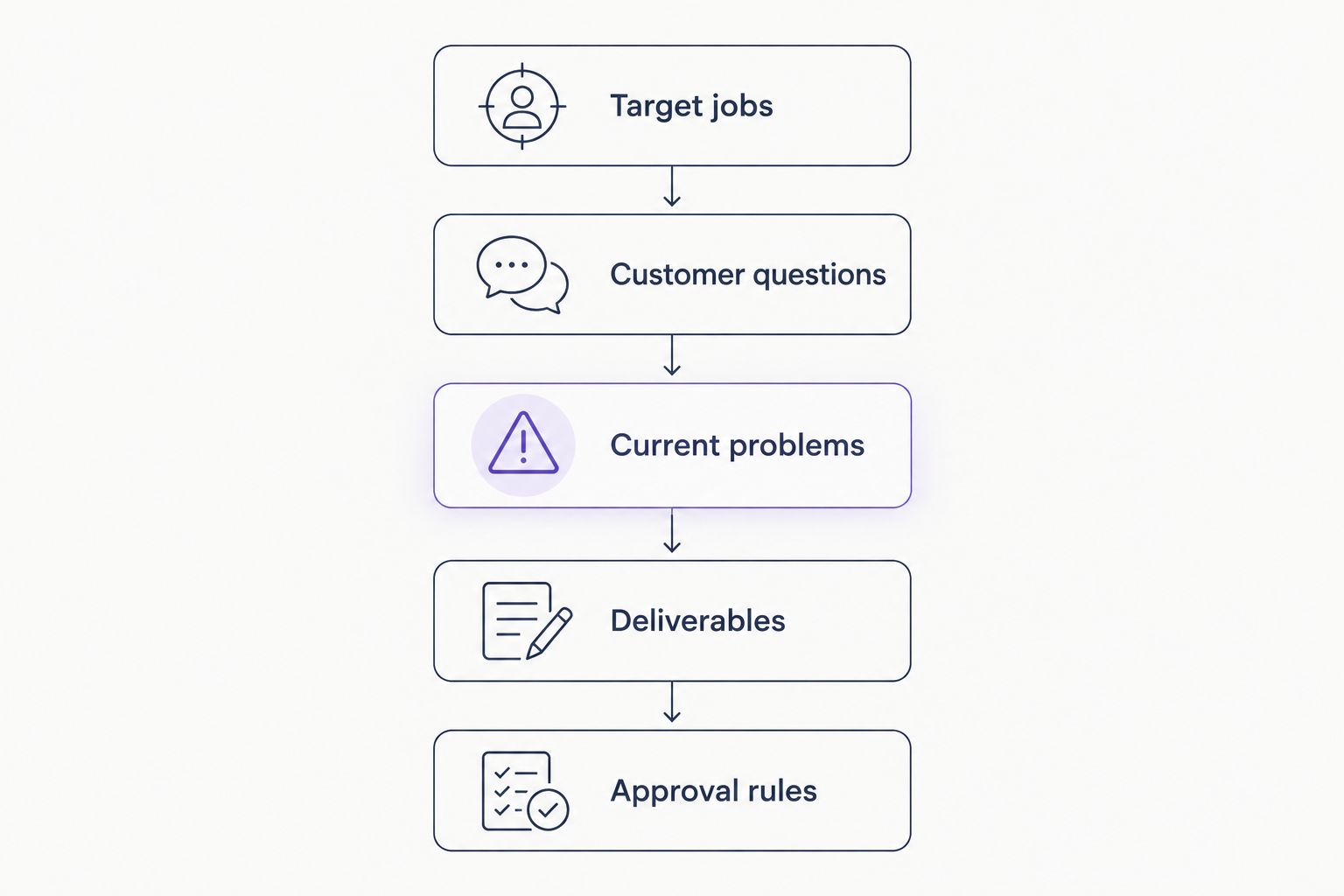
1. Name the jobs you want
Write down your priority work. Specify roof replacement, repairs, inspections, commercial projects, or another service you actually provide.
Then explain what makes an inquiry a good fit. Include property type, service area, and the customer's immediate need. If you do not take certain work, say so.
For example, a contractor could write: prioritize residential replacement inquiries within our actual service area; do not build the message around commercial roofing. Treat that as a model, not a claim about your company.
2. Describe the customer and the decision
Explain who contacts you and who approves the job. A homeowner comparing replacement estimates has different questions from a property manager coordinating maintenance.
Describe the questions customers ask before booking. Use actual call notes or messages, with personal details removed. Those questions give the agency useful material for headlines, service descriptions, and inquiry forms.
Avoid a target audience as broad as everyone who needs a roof. It gives the agency nothing to prioritize.
3. Show what is broken
Name the specific problem with your current materials. Perhaps the company name is hard to read on a truck, the website lists work you no longer take, or your social profiles use an old logo.
Attach examples and explain the business consequence you want to address. Separate an observation from a measured result: an outdated phone number is observable; lost revenue requires evidence.
Do not turn a dislike into a performance claim. Saying the homepage feels dated is different from proving that it caused fewer inquiries.
4. Define the deliverables
List exactly what you want the agency to produce. Logo design, brand guidelines, website design, and social media management are separate pieces of work.
For each item, state where you will use it and what you need to receive. A logo for a website header also needs consideration for workwear, vehicles, and printed estimates if those uses are in scope.
Ask the agency to confirm file formats, editable files, usage rights, and handoff responsibilities in the proposal. Do not assume those details are included.
5. Set approval and handoff rules
Name the person who collects feedback and the person who gives final approval. If those are different people, explain how decisions move between them.
State that previews come before publication. Any website launch, profile update, or replacement of public-facing materials needs your written approval.
Your brief should also identify who controls the domain, website hosting, and business accounts. Arrange access deliberately rather than sending passwords inside the brief.
Choose the scope before choosing the look
A logo refresh, a full brand project, and website-led work solve different problems. Use the smallest scope that addresses your actual problem—not the smallest scope that leaves the problem untouched.
| Scope | Best for | Main advantage | Main limitation |
|---|---|---|---|
| Logo refresh | Contractors keeping their positioning but fixing an unclear mark | Keeps the assignment focused | Does not fix weak service copy or a confusing website |
| Brand identity and messaging | Contractors needing consistent words and visuals | Sets direction across customer-facing materials | Requires decisions beyond personal design preferences |
| Website-led project | Contractors whose main problem is unclear online information or contact paths | Focuses work on the website experience | Does not automatically update trucks, uniforms, or social accounts |
Logo refresh: best for a focused visual problem
Choose a logo refresh when your business direction is clear and the mark itself needs work. Explain what should remain recognizable and where the current logo fails.
The trade-off is scope. A cleaner logo will not correct inaccurate service information, an unanswered contact form, or inconsistent sales follow-up.
Brand identity and messaging: best for consistency
Choose broader branding work when your company sounds and looks different everywhere. Specify whether the assignment includes positioning, written messaging, visual guidelines, or applications such as estimate covers.
This requires owner input. The agency needs real answers about services and customers, not permission to invent a company story.
Website-led work: best for a website problem
Choose website-led work when customers cannot easily understand your services, coverage, or next step. Supply the approved service list and explain how inquiries reach your team.
Keep the boundary clear. Website design does not automatically include ongoing social media management or replacement vehicle graphics.
Moore Media Collective is a fit for roofing contractors seeking branding, website design, and social media management. Those services match the stated offering, but the project still needs an agreed scope; review the agency services against your brief rather than assuming every task is included.
What changes the scope of a roofing branding brief?
The assignment changes with what you need to replace, explain, and approve. Put these factors in your brief so the proposal addresses the whole job.
- Service mix: Identify which roofing services need priority and which should stay secondary.
- Customer type: Explain whether the message addresses homeowners, property managers, or another actual buyer.
- Existing materials: List the website, signs, vehicles, workwear, documents, and profiles affected by the work.
- Available evidence: Identify usable project photos, approved reviews, and verified business details.
- Decision process: Name the approver and explain how feedback will be collected.
- Launch dependencies: Flag printing, website access, account ownership, and other work that must be coordinated.
Copy this roofing branding brief for 2026
Keep the core brief to a recommended 1 page, then attach supporting materials. That limit is a writing discipline, not a rule about project size: it forces you to put the important decisions first.
Use the following prompts as field names. Answer them plainly, and remove instructions that do not apply.
- Planning year: 2026.
- Business basics: Legal business name, public-facing name, contact person, and actual service area.
- Main objective: The business problem this project should address.
- Priority work: Roofing services and customer types you want the message to emphasize.
- Poor-fit work: Services, locations, or requests you do not take.
- Current problem: Specific examples of confusing, outdated, or inconsistent materials.
- Requested scope: Deliverables, intended uses, and anything explicitly excluded.
- Keep unchanged: Recognizable elements, approved wording, or materials that must remain.
- Supporting evidence: Project photos, approved customer feedback, and verified credentials where applicable.
- Creative direction: Examples you like or dislike, with a reason for each.
- Commercial boundaries: Your budget expectations, decision process, and requested completion date.
- Approval rule: No public changes without written approval from the named decision-maker.
- Success check: What you will review after launch and who owns that review.
If your 2026 project includes a website, add the current inquiry route. Explain who answers calls, where forms arrive, and what happens when the office is closed. Do not ask the site to promise a response your team cannot provide.
What should I send with my roofing branding brief?
Send real examples that help the agency make decisions. A pile of files without explanations creates another sorting job.
Start with 3 completed jobs as a recommended sample. For each, include the service performed, customer type, usable photos, and why you want more work like it. Remove private customer details and confirm permission before anything is published.
Include your existing logo files, current printed materials, approved business details, and examples of customer questions. Mark each item as current, outdated, or reference-only so old information does not slip into new work.
For design references, explain the feature—not just the feeling. You might like a readable company name, a clear service list, or consistent project photography. Asking an agency to copy another contractor's identity is not a useful direction.
How do I give feedback without dragging the project out?
Give consolidated feedback tied to the brief. The approver should resolve internal disagreements before sending instructions back to the agency.
Review work in 2 formats as a practical starting point: its main digital use and a relevant physical use. For a roofing logo, that could mean a website header and a vehicle graphic mockup. The purpose is to check the application, not admire an isolated mark.
Use a clear feedback pattern: observation, problem, requested direction. For example, explain that the service description is hard to read in the proposed application and ask for a version that gives it more space.
Before approving your 2026 materials, check the business name, phone number, service area, and service claims. A polished layout does not make incorrect information safe to publish.
How do I know whether the branding project worked?
Agree on the evaluation before launch. Separate delivery checks from business outcomes so you do not mistake finished files for booked jobs.
Delivery checks include receiving agreed assets, confirming accurate information, and testing inquiry routes. Business checks include reviewing qualified inquiries and booked work using records your business already keeps.
Compare like-for-like periods and record other changes, such as advertising or service coverage. Do not credit the entire result to design when several things changed together. Branding supports how you present the business; it does not replace answering the phone or following up on estimates.
FAQ
What's the first thing I should tell a roofing branding agency?
Tell the agency which roofing jobs you want and who buys them. Then explain the specific problem your current branding or website creates.
How long should my roofing branding brief be?
Use 1 page for the core brief as a practical starting point, with supporting files attached separately. Keep the objective, scope, decision-maker, and approval rule easy to find.
Do I need a new logo or a full roofing rebrand?
Choose a logo refresh for a focused problem with the mark; choose broader branding work when messaging and visual consistency also need attention. Neither scope automatically fixes website functionality.
Should I send other roofers' websites as examples?
Yes, send examples with a specific explanation of what you find useful. Identify readable layouts or clear service information rather than asking the agency to copy another business.
Can a branding agency change my live roofing website without asking?
Require written approval before any live website change. Name the approver and ask for a preview so publication is a deliberate decision.
Is Moore Media Collective an option for roofing branding?
Moore Media Collective provides branding, website design, and social media management for roofing companies and other trades. Confirm deliverables, exclusions, and approval requirements in the project agreement.
Will a roofing rebrand guarantee more booked jobs?
No, a roofing rebrand does not guarantee more booked jobs. Review qualified inquiries and booked work alongside advertising, call handling, and estimate follow-up.
One last thing
Put a “do not change” list beside your wish list. Include anything that must stay recognizable, any accurate wording that must remain, and any public material that cannot change before approval.
That list protects the useful parts of your business while the agency fixes the weak ones. Before sending your brief, read it as if you knew nothing about your company: can you tell which jobs matter, what needs making, and who says yes?