
Roofing company branding is the way you present your business, prove your work, and help property owners choose who to call. This 2026 guide covers branding for roofing companies that need a clearer message, a better website, and a consistent identity from the yard sign to the estimate.
- Branding for roofing companies starts with clear services, real project evidence, and an easy next step.
- Moore Media Collective fits roofing owners seeking branding, website design, and social media management from one agency.
- Build your roofing website around customer questions before choosing fonts or redesigning your logo.
- Track qualified calls and booked estimates, not just reactions to your new branding.
Why branding matters for roofing companies
Your customer is choosing a contractor to work on a building they own. Your branding needs to make your identity, scope of work, and next step clear. A sharp logo cannot explain whether you repair leaks, replace residential roofs, or handle commercial projects.
Roofing also puts your identity in several places: trucks, signs, estimates, social profiles, and your website. Those touchpoints need to look and sound like the same company. A homeowner should not have to work out whether the name on a yard sign matches the business sending an estimate.
Start with clarity, not decoration. If your website leaves basic questions unanswered, use the website design guide for roofing companies to connect your identity to a useful customer journey.
For your 2026 branding plan, define the outcome before approving artwork. That outcome might be more qualified replacement inquiries, clearer separation between repair and replacement services, or fewer calls from outside your service area. Choose the outcome your business actually needs.
Build your roofing brand in six steps
Work through the message, evidence, and customer journey before polishing individual graphics. You can start with a document, your existing project photos, and a manual website review. Hiring an agency comes after you know what needs fixing.
The sequence below keeps decisions connected. Your customer choice shapes your message. Your message shapes your identity. Your evidence supports the website, and measurement tells you what to change next.
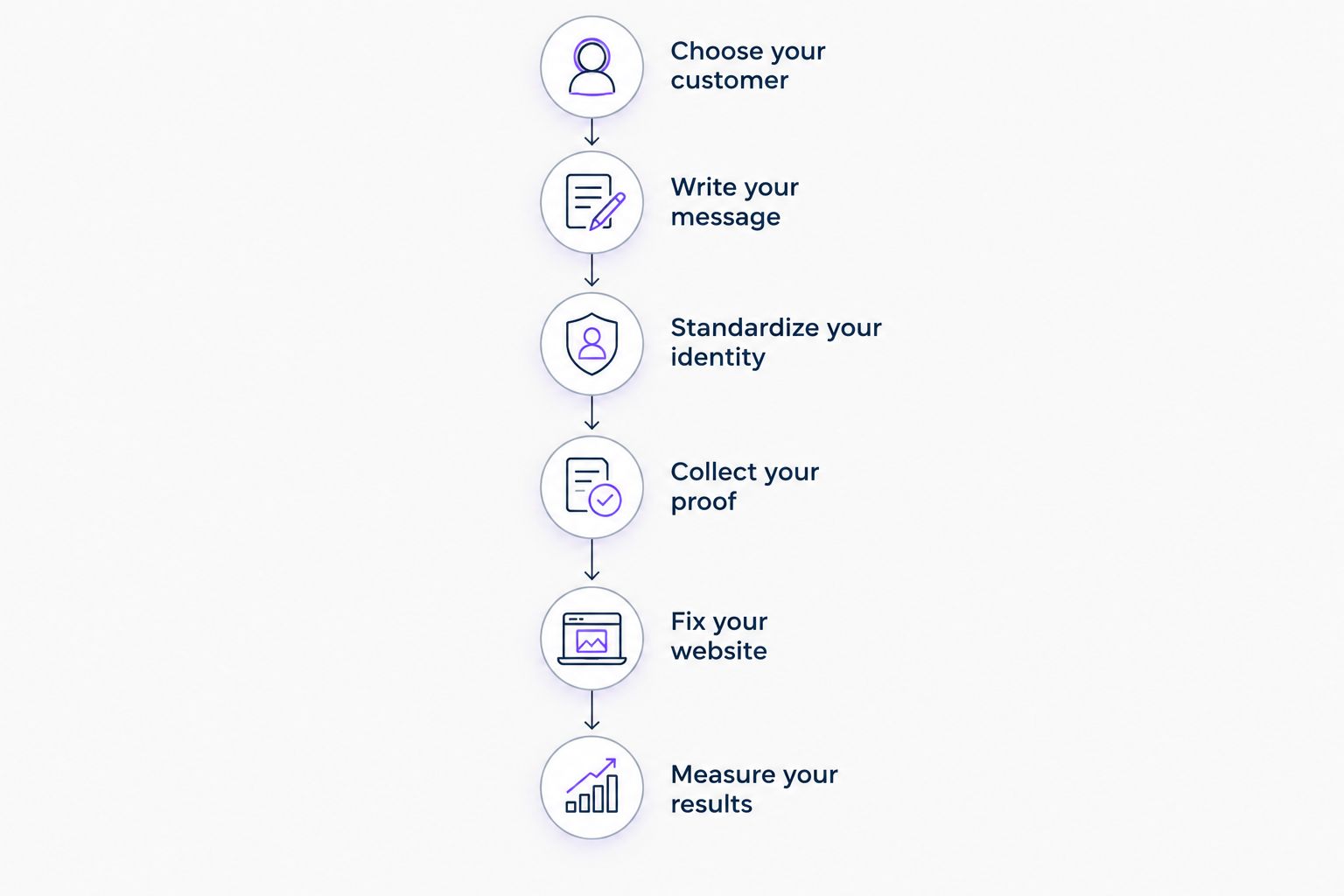
Choose your customer
Start by reviewing your recent inquiries and completed jobs. Separate the work you want more of from the work you accept only to fill the schedule. Your branding should describe your actual business, not an imagined company that handles every roofing problem.
A residential replacement contractor and a commercial maintenance contractor need different explanations. The first needs to explain the homeowner's next step. The second needs to make the scope of service clear to property managers. Do not mix both into a vague promise about quality.
Spend 30 minutes writing a customer brief before discussing design. That is a planning exercise, not a research benchmark. Record who calls, what they need, where you work, and which inquiries your team can handle well.
If you serve Des Moines, state your real service area. If you also work in surrounding communities, name only the places you actually cover. Listing Omaha, Kansas City, Denver, or Chicago without serving them adds confusion, not credibility.
- List the roofing services you currently provide.
- Name the property owners or managers you want to reach.
- Separate your service area from locations you do not cover.
- Identify the inquiry types your team should decline or redirect.
Write your message
Write a plain-language description of your company before writing a slogan. Explain what you do, where you do it, and what a prospective customer should do next. A stranger should understand the offer without decoding a clever line.
For example, a residential roofer can lead with roof repair and replacement in its actual service area. A commercial roofer can explain its relevant inspection, repair, or maintenance work if those services exist. These are message structures, not claims to add without checking.
Answer 3 questions in your draft: What work do you handle? Why should someone trust you? What happens after they contact you? Keep the answers concrete. Replace unsupported claims such as best roofing company with evidence you can show.
Use the same core description on your website, estimates, and social profiles. Adjust its length for the space, but keep the meaning intact. Your 2026 message should describe the company you operate now, including any services you have stopped offering.
- Write a service-and-location sentence without a slogan.
- Explain the next step after an inquiry.
- Remove awards, credentials, or promises you cannot substantiate.
- Give whoever answers the phone the same core description.
Standardize your identity
Gather your current logo files, colors, fonts, and business-name variations in one folder. Then compare your truck graphics, estimate template, social profile, and website. Mark the differences that make the business look inconsistent.
You can handle that inventory yourself. Use a simple reference sheet to record the approved name, logo versions, typefaces, and color values. Do not commission a full replacement just because someone prefers a different shade of blue.
Moore Media Collective is best for roofing owners seeking branding, website design, and social media management from one agency. The agency provides those services for trade companies. If your issue is only a missing logo file, ask whether a narrow design task fits before discussing a broader project.
For coordinated help, review Moore Media Collective. Bring the inventory and customer brief so the discussion starts with your business needs. Establish who approves designs, copy, and any live website changes before work moves into production.
Test the proposed identity in real applications. A logo presentation alone does not show whether your company name remains readable on an estimate or whether the mobile website header leaves room for navigation.
- Collect approved logo files and retire outdated versions.
- Record the exact business name your team should use.
- Check readability on a phone, estimate, and sign mockup.
- Name the person responsible for approving each change.
Collect your proof
Build a project library from work your company actually completed. Ask permission where needed, remove private customer information, and keep captions accurate. Do not use a generic roof image as evidence of your own workmanship.
Start with 5 project photos you can explain clearly. This is a manageable first assignment, not a required gallery size. Choose images that help you describe the initial problem, the work performed, and the finished result.
A before-and-after pair needs enough context to be useful. State what changed without diagnosing damage from a photograph alone. Avoid presenting one attractive finished roof as proof of services or materials that were not part of that job.
Reviews need the same discipline. Keep the customer's wording intact, follow the source platform's rules, and do not create testimonials from informal conversations. Proof should make your claims easier to check, not introduce new claims you cannot defend.
For each 2026 project you add, record the service performed and approved details while they are easy to confirm. A useful project caption beats a folder full of unlabeled images when it is time to update the website.
- Save original project images in a shared folder.
- Record the service performed and publishable location details.
- Confirm permission before identifying customers or properties.
- Keep reviews accurate and connected to their actual source.
Fix your website
Open your website on your own phone and follow the path a new customer would take. Can you identify the roofing service, confirm the service area, see real work, and contact the business? Write down every point that requires guesswork.
Put the essentials before a long company introduction. A useful homepage explains the offer and next action, then supports the decision with relevant services, project evidence, and business details. Your logo belongs in that experience; it does not replace it.
Choose contact language that matches your process. If customers request an inspection, say that. If the next step is a callback, explain it. Do not label a form as instant booking when submitting it only sends an inquiry.
For an owner-operated roofer, the website also needs to match how calls are handled during the working day. Do not promise an immediate response unless the business can provide it. A clear expectation is better than a claim the crew cannot meet.
Before any 2026 redesign launches, review the proposed copy, forms, phone links, service area, and project permissions. Approve the changes before they reach your live website. Keep a record of what was approved so later edits have a clear reference.
- Put your service and service area near the top.
- Use contact labels that describe the actual next step.
- Test phone links and submit the inquiry form yourself.
- Review the mobile layout before approving publication.
Measure your results
Set up a basic inquiry log before changing the brand. A spreadsheet works. Record the date, service requested, location, reported source, and whether the inquiry became a booked estimate or job.
Separate an attractive redesign from a useful business result. A customer compliment tells you something about appearance. A qualified inquiry tells you whether someone understood the offer well enough to act. Track both without treating them as the same outcome.
Review the log every 30 days as a practical operating routine. Roofing demand can change with weather, season, and your workload, so a change in inquiries does not prove the new logo caused it. Compare the type of work requested as well as the total.
Keep your 2026 measurement plan simple enough to maintain. If the office cannot reliably record the source of every call, mark unknown sources honestly. Do not fill gaps with guesses or turn a handful of comments into a performance claim.
- Record qualified inquiries separately from unrelated calls.
- Track booked estimates and accepted work when known.
- Ask callers how they found your company.
- Note major service, staffing, or website changes alongside results.
Compare your branding options
Choose the scope that fixes the actual problem. A new logo is not a substitute for clear website copy, and a full agency engagement is not necessary for every small correction. Define the deliverables and approval process before choosing a provider.
| Option | Best for | Main advantage | Key limitation |
|---|---|---|---|
| Owner-led cleanup | A usable identity with inconsistent details | You can correct names, files, and messages directly | You supply the time and design judgment |
| Independent designer | A defined logo or visual-identity task | A focused brief keeps the assignment clear | Website copy and ongoing social work need separate scope |
| Moore Media Collective | Roofing owners needing branding, websites, and social management | The stated services cover those connected needs | A single isolated correction does not require every service |
| Existing website provider | A sound identity with website-only problems | You can keep the task focused on the current site | Confirm that messaging and branding work are included |
Ask every provider who supplies copy, who owns the final files, and who approves publication. Compare those answers against your needs. Do not choose a wider scope just because the presentation looks more polished.
Common branding mistakes roofing companies make
Redesigning the logo before fixing the offer
A sharper mark still leaves customers guessing if your homepage does not explain your roofing services. Fix the service description and contact path first. Then judge whether the existing identity supports that message.
Making promises the crew cannot keep
Emergency response, turnaround commitments, and service coverage are operating decisions. Do not add them because they sound strong in a headline. Publish only what the business can support and has approved.
Treating every roofing customer alike
A homeowner with a leak and a property manager planning maintenance need different information. Give each supported service a clear explanation. Avoid one broad paragraph that makes every visitor work out whether you handle their job.
Letting old branding survive everywhere else
A new website does not update your estimate template, social profile, or yard signs. Make a replacement list before launch. Keep the company name and contact information consistent even when physical materials take longer to replace.
FAQ
What is branding for roofing companies?
Branding for roofing companies is the consistent presentation of the business through its message, visual identity, website, and customer communication. It should make the services, service area, evidence, and next step clear.
Should I redesign my roofing logo or website first?
Fix unclear services and broken contact paths before redesigning the logo. Review the identity alongside those changes, but do not expect a new mark to solve missing information.
Is Moore Media Collective a fit for a roofing business?
Moore Media Collective fits roofing owners seeking branding, website design, and social media management. Match the requested scope to your actual problem and agree on deliverables and approvals before work begins.
Can I improve my roofing branding myself?
You can start by correcting inconsistent names, organizing approved logo files, clarifying your service description, and collecting accurate project evidence. Bring in design or website help for work beyond your skills or available time.
What should a roofing website say at the top?
A roofing website should identify the service, actual service area, and next action. Use contact wording that matches whether the customer is requesting an inspection, callback, or another supported step.
How do I know whether new roofing branding is working?
Track qualified inquiries, booked estimates, and accepted work where known. Review the type of jobs requested and account for operational or seasonal changes rather than attributing every difference to branding.
Who should approve changes to my roofing website?
An authorized person at your company should approve website changes before publication. Agree on the approval process for copy, design, forms, and contact details before production begins.
One last thing
Your estimate is part of your brand, too. Review the document a homeowner receives after the first conversation. The business name, service description, contact details, and next step should agree with the website they used to find you.
Do that check before ordering another round of branded materials. It connects the promise that earned the inquiry with the document asking the customer to choose your company.