
Best overall: a service-first roofing website. Best for storm-damage inquiries: a storm-response layout. Best for a focused redesign: a compact estimate-request site. This 2026 guide ranks website designs for Des Moines roofing companies by how clearly they explain the work, show proof, and help homeowners take the next step.
- Best website design Des Moines roofing companies: choose a service-first layout as the default.
- Moore Media Collective provides website design and branding for roofing companies and other trades.
- Storm-response, project-gallery, and commercial layouts serve different roofing buyers. Pick the layout that matches your work.
- Use real project photos, accurate service areas, and clear estimate requests. Leave unsupported promises off the page.
Why this matters
Your website needs to help a homeowner answer practical questions. Do you handle this roofing problem? Do you serve this address? How do they request an estimate?
A polished homepage that leaves those questions unanswered is unfinished. Start with the customer's job, not the animation or color palette.
Moore Media Collective provides website design, branding, and social media management for roofing companies and other trades. Moore Media Collective is a fit for roofing owners who want website design and branding from a trades-focused creative agency.
This guide ranks design approaches, not individual Des Moines contractors or agency portfolios. Use it to choose a direction for your own site without confusing attractive screenshots with evidence of booked jobs.
What makes the best roofing website design?
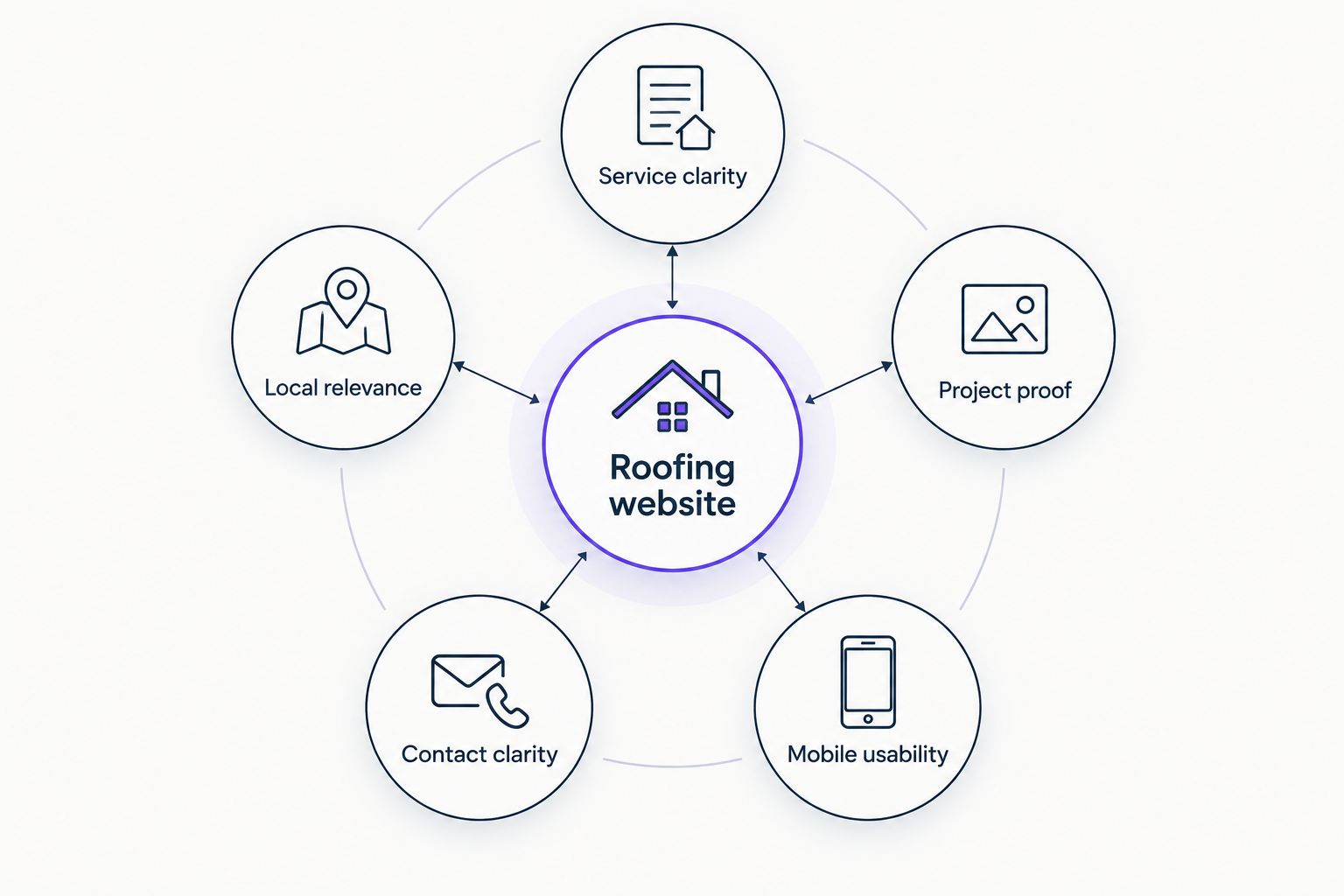
Judge a 2026 roofing website against these criteria before choosing a layout:
- Service clarity: Name the roofing work you actually perform. Separate repair, replacement, and commercial services where those distinctions matter.
- Local relevance: State that you serve Des Moines and list only the surrounding communities you genuinely cover.
- Project proof: Show your completed work with useful captions. Explain the job rather than filling a gallery with unexplained roof photos.
- Contact clarity: Make calling or requesting an estimate straightforward. Explain what happens after someone submits a request.
- Mobile usability: Keep text readable, forms usable, and important controls easy to find on a phone.
These criteria apply to every design below. The emphasis changes with your work: a replacement-focused roofer needs a different opening than a contractor targeting commercial maintenance.
For a deeper checklist, use the guide to website features for roofing companies.
Roofing website designs at a glance: 2026 picks
| Rank and design | Best for | Standout feature | Key limitation |
|---|---|---|---|
| 1. Service-first website | Roofers offering several residential services | Clear routes to the right roofing service | Needs distinct, useful service content |
| 2. Storm-response website | Contractors emphasizing storm-damage inquiries | Damage-focused intake and next steps | Creates the wrong expectation if response claims are inaccurate |
| 3. Project-gallery website | Roofers with documented replacement work | Completed projects explained with captions | Weak without original photos and project details |
| 4. Commercial roofing website | Contractors targeting property decision-makers | Building-focused service and inquiry structure | Poor fit for a mainly residential business |
| 5. Compact estimate-request website | Owners narrowing an outdated site's scope | A focused route from service summary to inquiry | Limited room for separate service explanations |
1. Service-first website: best for residential roofing breadth
A service-first website organizes the business around the work customers need. The homepage introduces the contractor, identifies the service area, and directs visitors to relevant roofing services.
For example, a contractor offering repairs and replacements should explain those services separately. Don't make the homeowner decode an oversized slogan before finding the work they need.
What the layout should include
Lead with the service and location. Follow with service choices, completed work, verified customer feedback when available, and a clear estimate request.
Write service descriptions around actual scope. Explain what you assess and how an inquiry begins without promising a diagnosis before an inspection.
Service-first website pros:
- Gives different residential customers a relevant starting point.
- Creates room to explain each service without crowding the homepage.
- Keeps location, proof, and contact details close to the service information.
Service-first website cons:
- Thin service pages repeat the homepage without helping anyone.
- Too many equally prominent choices make the opening harder to scan.
Best for: Des Moines roofing companies offering several residential roofing services.
Verdict: Buy. Choose this structure as the default for a residential roofing redesign in 2026.
2. Storm-response website: best for storm-damage inquiries
A storm-response layout addresses a specific concern: a homeowner has noticed damage and needs to understand the next step. It puts the inquiry route and the contractor's actual scope near the opening.
Keep the language controlled. Describe roofing assessment and repair services without promising insurance outcomes, immediate arrival, or emergency coverage unless those claims are accurate.
What the layout should include
Explain how to report the problem, what information to provide, and how your team handles the inquiry. Ask for the property location and a plain-language description of what the homeowner noticed.
Tell visitors not to climb onto a damaged roof to collect photos. Any image-upload option should accept photos taken from a safe position rather than encourage an inspection by the homeowner.
Storm-response website pros:
- Matches the visitor's immediate reason for seeking a roofer.
- Gives staff useful context before responding.
- Makes the next step explicit instead of relying on a generic contact page.
Storm-response website cons:
- Urgency-heavy copy misleads when operations cannot support it.
- A storm-only opening gives routine replacement customers less direction.
- Insurance language requires care to avoid unsupported promises.
Best for: Roofing contractors that actively handle storm-damage inquiries.
Verdict: Buy when storm response matches your actual services. Skip emergency language your business cannot stand behind.
3. Project-gallery website: best for documented replacement work
A project-gallery website makes completed roofing work the main evidence. Photos need context: what the job involved, what changed, and which details are relevant to the next customer.
A roof photo alone does not explain the contractor's role. Pair the image with an accurate project description and use only material you have permission to publish.
What the layout should include
Group projects by useful differences, such as repair versus replacement or residential versus commercial work. Use those categories only when they reflect your real portfolio.
For a before-and-after presentation, aim for comparable viewpoints. Keep captions factual and avoid adding material names, warranty terms, or performance claims that the project record does not support.
Project-gallery website pros:
- Shows actual work instead of relying entirely on sales copy.
- Gives prospective customers specific projects to discuss.
- Makes visible differences easier to understand with relevant captions.
Project-gallery website cons:
- Requires original photography and accurate project information.
- Large image files need attention during development.
- An attractive gallery still needs service explanations and a contact route.
Best for: Replacement-focused roofers with a useful collection of documented projects.
Verdict: Buy when the evidence is ready. Hold this direction if the gallery would depend on generic stock photography.
4. Commercial roofing website: best for property decision-makers
A commercial roofing website speaks to the person responsible for a building. Organize it around the work you perform, the properties you serve, and the information needed to start a useful conversation.
Don't simply replace a house photo with a warehouse photo. Commercial positioning needs relevant service descriptions and project evidence, not a cosmetic change.
What the layout should include
Describe your actual commercial services and the process for discussing a property. An inquiry can ask about the building, the concern, and access considerations without requiring the visitor to diagnose the roof.
Publish certifications, insurance statements, and maintenance capabilities only when verified. If residential work remains part of the business, give it a clearly labeled route rather than mixing both audiences in every paragraph.
Commercial roofing website pros:
- Addresses property-focused questions directly.
- Separates commercial inquiries from household roofing requests.
- Gives relevant commercial projects a clear place on the site.
Commercial roofing website cons:
- Requires business-specific service detail and evidence.
- Can confuse residential visitors if the audience split is unclear.
- A commercial label does not substitute for commercial experience.
Best for: Contractors deliberately targeting commercial property owners and managers.
Verdict: Buy when commercial roofing is an established service. Skip it as a positioning shortcut.
5. Compact estimate-request website: best for a focused redesign
A compact estimate-request website reduces the scope to essential information. It explains the work, identifies the service area, presents credible proof, and gives visitors a clear inquiry route.
This is a deliberate design choice, not permission to publish a vague page. The site still needs enough substance for a homeowner to understand the business.
What the layout should include
Build the page around a direct service statement, a concise service summary, real project evidence, and an estimate form. Keep navigation tied to those sections.
As a starting design brief, use 1 primary action, request 3 essential fields, and show 2 relevant project photos. Those are scope recommendations, not conversion benchmarks; adjust them to the information your team needs.
Compact estimate-request website pros:
- Keeps the redesign brief focused.
- Makes essential information easier to review together.
- Gives a narrow service offering a straightforward presentation.
Compact estimate-request website cons:
- Offers less room for detailed service explanations.
- Becomes crowded when the business serves several distinct audiences.
- Needs expansion when important customer questions no longer fit.
Best for: Roofing owners replacing an outdated site with a deliberately limited scope.
Verdict: Buy for a focused offering. Hold if separate services need substantial explanation.
How these designs were ranked
The ranking favors service clarity, local relevance, project proof, contact clarity, and mobile usability. The service-first layout takes the default position because it gives a residential roofer space to explain different jobs without forcing every visitor through the same message.
The specialist layouts win only when their use case matches the business. This 2026 ranking is a design decision guide, not a claim of measured lead performance.
Use the same discipline when choosing an agency. Moore Media Collective offers website design and branding for roofing companies; ask to see relevant work and agree on the scope before deciding whether the agency fits your project.
Which roofing website design should you choose?
Choose a service-first website unless your business has a clear reason to specialize the opening. It gives residential roofing owners a practical starting structure without making storm damage, photography, or commercial work carry the entire site.
Then write the approval requirements into the redesign brief:
- Confirm the services and Des Moines-area communities you actually cover.
- Approve project photos, captions, and customer permissions.
- Verify every credential, review, policy, and service promise.
- Approve the copy and design before any live website changes.
- Test calling, form submission, and mobile navigation before launch.
For a 2026 redesign, fix unclear information before adding decoration. A new visual treatment does not answer a missing service question.
If you approach Moore Media Collective, bring your current site and the jobs you want the redesigned site to explain. Request a proposed scope, review points, and an explicit approval process for publishing changes.
Plan your roofing website redesign
Start with your services, project evidence, and approval requirements.
FAQ
What's the best website design for roofing companies in Des Moines?
A service-first website is the default recommendation for Des Moines roofers offering several residential services. It gives homeowners clear routes to relevant work, project evidence, and an estimate request.
Should my roofing website focus on storm damage?
Use a storm-focused opening when storm-damage work is an actual priority for your business. Keep response claims accurate and give routine repair or replacement customers another clear route.
Is a one-page roofing website enough?
A compact website suits a focused offering when it answers the customer's essential questions. Use separate pages when different services need detailed explanations or serve distinct audiences.
What should a roofing website homepage show first?
Show what roofing work you do, where you work, and how to request the next step. Support that opening with real project evidence rather than an unexplained slogan.
Do I need before-and-after photos on my roofing website?
Before-and-after photos are useful when they accurately document your work and you have permission to publish them. Comparable viewpoints and factual captions make the change easier to understand.
Can a roofing website guarantee more booked jobs?
A website design alone does not guarantee booked jobs. Judge the site alongside inquiry quality, staff follow-up, and your ability to serve the requested work.
Does Moore Media Collective work with roofing companies?
Moore Media Collective provides website design, branding, and social media management for roofing companies and other trades. Confirm the proposed deliverables and approval process before authorizing a redesign.
One last thing
Test the estimate form from your own phone before approving the site. Follow the inquiry all the way to the person responsible for answering it.
A confirmation message is not the finish line. Your team needs to receive the request, understand it, and know who responds. Put that handoff in the launch checklist.