
Roofing-company branding needs a quote tied to specific deliverables, not a single budget figure applied to every contractor. Separate logo design, a complete visual identity, and the work of updating your website and marketing materials; a design quote does not establish that printing, installation, or website changes are included.
- How much does branding cost for a roofing company? Define logo design, visual identity, and rollout before comparing quotes.
- Choose logo-only work when your existing website and marketing materials already work together.
- Request separate approval for website changes, printed materials, and other rollout work.
- Moore Media Collective provides branding, websites, and social media management for roofing companies.
How much does branding cost for a roofing company?
The useful answer is a written quote for a defined scope. A logo file, a visual identity, and a business-wide rollout are different purchases. Compare them as separate scopes before choosing a provider.
For your 2026 branding project, start with these 3 scope options. They are a way to organize your brief, not named agency packages. Review the available branding and website services against the work your roofing business actually needs.
| Scope option | Best for | What to request | Main limitation |
|---|---|---|---|
| Logo design | A roofer keeping an otherwise usable identity | Agreed logo versions, editable files, and usage rights | Does not resolve inconsistent website layouts or marketing materials |
| Visual identity | A roofer whose materials look unrelated | Logo, colors, fonts, and practical usage guidance | Does not mean existing materials get updated |
| Identity and rollout | A roofer changing how the business appears across customer touchpoints | Identity work plus a named list of website, social, and print applications | Requires more coordination and clear approval boundaries |
Do not compare quotes until you can put them in the same row. A smaller scope is not automatically a better deal. A larger scope is not automatically necessary.
Ask each provider to list deliverables, exclusions, revision rules, file ownership, and implementation responsibilities. You should be able to identify what you receive without interpreting a sales presentation.
Why this matters: your customer sees the whole business
A homeowner can encounter your roofing business through a yard sign, a truck, a social profile, or your website. Branding work should account for those places, not end with a logo that looks good in a presentation.
Your goal is practical: make the business easy to recognize and make the next step clear. A consistent identity supports that job. It does not replace accurate service information, real project photos, or a working contact form.
For a roofing company in Des Moines, for example, the website still needs to explain the work offered and the area served. A new typeface cannot fix missing service information. Put each problem in the right scope before you approve the project.
Logo design: keep the job narrow when the problem is narrow
Best for: roofing owners who need a usable logo without rebuilding everything else. Choose this scope when you intend to keep your existing website structure and marketing materials.
Write down the places where the logo must work. Include a website header, social profile image, estimate document, yard sign, or truck application when those uses apply to your business. Ask the designer to show the proposed mark in those settings.
A detailed roof illustration might look readable when enlarged but become difficult to distinguish in a small profile image. Review the business name at the size customers will actually see it. Do not approve only the enlarged presentation.
The advantage is focus. The limitation is equally clear: a logo-only project leaves other design problems untouched. If your website, signs, and social graphics need new layouts, put that work in the brief rather than assuming it comes with the logo.
Visual identity: define the rules beyond the logo
Best for: roofing owners who want their materials to look like one business. Request a visual identity when the problem includes inconsistent colors, fonts, logo use, or layouts.
Your brief should name the guidance you need. That can include approved logo versions, color references, font choices, and examples showing how those elements work together. Ask which files and documentation you will receive.
Keep the guidance practical. Your office administrator should know which logo to place on an estimate. A sign supplier should know which files to request. Whoever makes social graphics should not have to guess which font belongs to the business.
The benefit is a shared set of decisions. The drawback is that guidance alone does not update anything already in circulation. If your 2026 plan includes replacing existing materials, list those applications separately.
Identity and rollout: name every item that changes
Best for: roofing owners who need approved branding applied across their business. Choose this scope when a new identity must also reach the website, customer documents, social graphics, or physical materials.
Build an application list before requesting the quote. Distinguish design work from production work. Designing a yard sign is different from printing it; preparing truck artwork is different from installing it.
For a website, identify whether you need a visual update, rewritten content, new page layouts, or a broader rebuild. These are separate decisions. A new logo in the header does not establish that the rest of the website has been redesigned.
Rollout gives you a defined path from approved designs to customer-facing materials. Its limitation is coordination: someone must supply content, approve proofs, and manage suppliers. Assign those responsibilities before work begins, and require approval before any live website change.
Why roofing branding scope varies
Use these factors to explain differences between proposals. Ask providers to connect each item to a deliverable rather than using broad phrases such as a complete brand experience.
- Starting point. Specify whether you are keeping the business name, refining an existing logo, or requesting a new identity.
- Required applications. Name the website pages, social templates, documents, signs, or vehicle artwork you want designed.
- Content work. State whether you will supply copy and photos or need those tasks included in the project.
- Revision process. Ask how feedback is collected, what a revision covers, and how a changed direction is handled.
- Production responsibility. Identify who prepares final files, checks supplier requirements, orders materials, and approves proofs.
- Website implementation. Separate proposed designs from building, testing, and publishing changes to the live site.
These questions belong in a 2026 brief before you compare proposals. They expose differences in scope without relying on an unsupported industry average.
Compare quotes with 5 questions
Read proposals side by side. Ignore the presentation style and find the answers to these questions.
- What exactly arrives at handoff? Look for named files, documents, templates, and applications. Ask for clarification when a deliverable is described only as branding.
- What stays outside the project? Confirm whether copy, photography, printing, installation, website work, or ongoing social management needs a separate agreement.
- How does approval work? Identify who gives feedback, who has final authority, and when an approved direction becomes the basis for further work.
- What can you do with the finished work? Request written terms covering usage rights, editable files, font requirements, and access to relevant accounts.
- What happens when the scope changes? Ask for a written change process before adding applications or reopening approved design decisions.
Choose the proposal that clearly covers your actual problem. Do not buy a full rollout to solve an isolated logo issue. Do not buy a logo-only scope when the real task is rebuilding your customer-facing materials.
For your 2026 comparison, keep a short decision sheet beside the proposals. Mark each requirement as included, excluded, or needing clarification. Resolve the unclear items before signing.
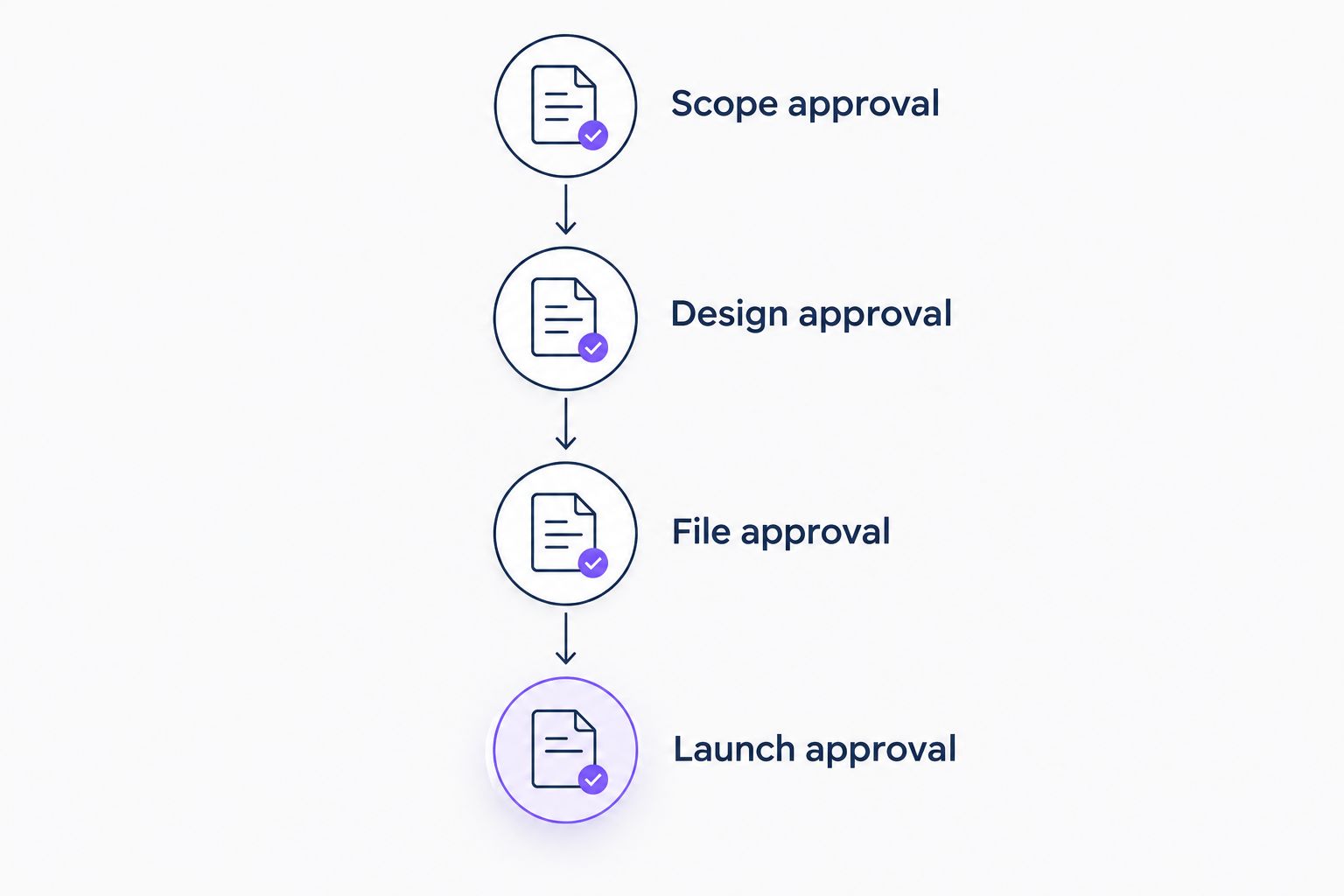
Use 4 approval checkpoints before anything goes live
Approval should cover more than whether you like the design. It should establish what the business is accepting and what happens next.
Scope approval
Approve the deliverable list, responsibilities, and exclusions first. Name the person authorized to give final feedback. If several people have input, collect their comments before sending a consolidated response.
Design approval
Review the proposed identity in relevant applications. Check the business name, readability, and suitability for the work you sell. Confirm the direction before asking for additional materials based on it.
File approval
Check that the agreed files and guidance are present. Ask which files belong with a printer, a sign supplier, and the person managing your website. Resolve missing assets before closing the design stage.
Launch approval
Review proposed website changes, social assets, and production proofs before publication or ordering. Get the correct decision-maker's sign-off. No live website change should happen without your approval.
Should you fix the website or the branding first?
Fix the problem that blocks a clear customer experience, then coordinate the remaining work. If the business name and identity are staying, a website project does not automatically require a complete rebrand.
Inspect the site on your phone. Can you identify the roofing services, service area, and contact action? Does the form work? Record those findings separately from design preferences such as disliking a color or wanting a different logo.
If you are changing the business name or identity, settle those decisions before approving final website visuals. Otherwise, you are asking the website team to design around elements that are still moving.
Moore Media Collective is a fit for roofing owners seeking branding, website design, and social media management from a creative agency. That service mix does not establish what your individual project includes; require a written scope and approval process.
Define your roofing branding scope
Discuss the branding, website, and social media work your roofing business needs.
Can you keep your existing roofing logo?
Keep the existing logo when it serves the business and the problem lies elsewhere. Review its readability, available files, and suitability for the applications you need before commissioning a replacement.
You can request website or template work around an existing identity. Ask the provider to identify any limitations early, especially when the only available logo file is unsuitable for the intended application.
Does a rebrand include social media management?
A rebrand does not establish that ongoing social media management is included. Designing profile assets and templates is different from planning posts, publishing content, or managing an ongoing account.
Moore Media Collective offers both branding and social media management. Put the work you want into the agreement rather than treating separate services as an automatic bundle.
FAQ
How much does branding cost for a roofing company in 2026?
Request a quote for a defined scope: logo design, visual identity, or identity and rollout. Compare deliverables, exclusions, revision terms, and implementation responsibilities before choosing a provider.
Is a roofing logo the same as a complete brand identity?
No. A logo is one asset; a visual identity can also define colors, fonts, logo use, and practical application guidance. Ask for the exact deliverable list.
Do I need a new logo before redesigning my roofing website?
No. Keep an existing logo when it remains suitable and the website needs separate improvements. If the identity is changing, approve it before finalizing website visuals.
Does roofing branding include truck graphics and yard signs?
Only when those applications are included in the written scope. Confirm design, production-file preparation, printing, and installation separately.
Can branding guarantee more roofing leads?
No. A new identity does not guarantee leads or booked jobs. Keep customer information clear and evaluate website inquiries separately from design approval.
What should I ask before hiring a roofing branding agency?
Ask what you receive, what is excluded, how revisions work, and who owns or can use the finished files. Confirm who approves publication and production.
Can Moore Media Collective help with roofing branding and websites?
Yes. Moore Media Collective provides branding, website design, and social media management for roofing companies. Confirm the specific deliverables and approval requirements for your project.
One last thing
Before approving your 2026 branding scope, ask how you will retrieve the final files after the project ends. Record the storage location, account access, and person responsible for keeping them organized.
Then give the brief a final read as an owner, not a designer. Does it address the materials customers actually encounter? Does it say what stays unchanged? Buy the work your business needs, with clear handoff and approval terms.