
An HVAC website costs according to the work included: design, page content, lead forms, connections to your business tools, and ongoing upkeep. For your 2026 budget, compare a written build quote with a separate list of recurring charges; a finished website does not automatically include hosting, updates, or search marketing.
- How much does a website cost for an HVAC company? The written scope determines your quote.
- Separate website design, content, and launch work from hosting, maintenance, and ongoing marketing.
- Moore Media Collective fits HVAC owners seeking website design alongside branding and social media management.
- Approve the scope, ownership terms, and launch plan before anyone changes your live website.
How much does a website cost for an HVAC company?
Your website budget should buy a defined result, not an undefined number of design hours. Ask what the contractor delivers, what you supply, and what remains your responsibility after launch. A quote without those answers is not ready for approval.
Start with the job your site needs to do. An HVAC repair company needs homeowners to understand its services and request help. A company focused on equipment replacement needs room to explain its installation process and help customers request an estimate.
Use this breakdown when reviewing a proposal. The website design guide for HVAC contractors provides a useful companion for defining the work before comparing bids.
| Budget component | What to ask the provider to define | What to check separately |
|---|---|---|
| Design and build | Page layouts, mobile behavior, and approved functionality | Whether future design changes are included |
| Website content | Who writes, edits, and approves each page | Photography, missing service details, and revisions |
| Lead handling | Forms, phone links, and the destination for inquiries | Connections to scheduling or customer-management tools |
| Launch work | Testing, domain setup, and treatment of existing page addresses | Responsibility for fixing launch problems |
| Ongoing care | Hosting, updates, backups, and support responsibilities | Renewal terms and work outside the agreement |
A 2026 proposal should make these boundaries clear. Do not assume that two providers quoting an “HVAC website” are offering the same work.
Why this matters
You want more calls and better-fit inquiries. That starts with making your services, service area, and next step easy to understand—not approving a prettier homepage and hoping the rest takes care of itself.
A homeowner looking for furnace repair should not have to work out whether you handle repairs, installations, or both. Your website should answer that question before asking for contact details.
Buy clarity before decoration. Design matters, but the proposal also needs to cover the words, contact paths, and handoff behind the design. Otherwise, you can approve the appearance while leaving the customer experience unfinished.
Compare 3 project scopes before comparing quotes
These are planning options, not named packages. Use them to decide what belongs in your project and what does not.
| Project scope | Best for | Main advantage | Main limitation |
|---|---|---|---|
| Focused refresh | Owners with useful content and a website that needs targeted fixes | Keeps the work centered on specific problems | Leaves anything outside the agreed changes untouched |
| Full rebuild | Owners whose structure, content, and design all need replacement | Lets you plan the customer journey as a whole | Requires more owner input and approval decisions |
| Rebuild with ongoing care | Owners who want defined help after launch | Establishes responsibility for agreed maintenance tasks | Requires clear boundaries between care and new project work |
Focused refresh: fix the named problems
A focused refresh starts with a list of defects. That list might include an unclear headline, a buried phone link, an awkward contact form, or service information that no longer matches your business.
Its strength is restraint. Its weakness is the same thing: it does not address problems outside the agreed scope.
Ask the provider to name the pages and elements being changed. “Refresh the website” is too loose. “Revise the homepage service summary and test the contact form” gives both sides something concrete to approve.
Full rebuild: replace the structure and content
A full rebuild suits an HVAC company whose existing site no longer explains the business properly. Plan the page structure, copy, customer proof, and inquiry process together.
The advantage is a coordinated site rather than a series of patches. The trade-off is preparation: someone must confirm service details, supply approved business information, and review the work.
Do not rebuild every page simply because it exists. Decide which pages still serve customers, which need rewriting, and which need a planned destination when the old site is replaced.
Rebuild with ongoing care: define the work after launch
Ongoing care is a separate agreement about what happens after the build. It should specify who handles the tasks you are buying, rather than relying on a broad promise to “manage everything.”
Ask whether content edits, technical updates, backups, and support requests are included. Also ask what requires a separate approval.
The benefit is assigned responsibility. The limitation is contractual: anything not covered still needs an owner and a process.
Why HVAC website quotes vary
Use these 5 quote drivers to explain differences between proposals. Ask each provider to describe the same work before deciding which offer fits.
- Page scope. List the pages you need and the purpose of each. A homepage, a repair page, and an installation page require different information; do not treat page count as a substitute for content planning.
- Content responsibility. Confirm who writes the copy and supplies approved photos. If you provide the material, agree on its format and when the designer needs it.
- Lead handling. A contact form and a connection to another business tool are different deliverables. Specify where inquiries go and how the receiving team confirms they arrived.
- Existing-site work. Identify the content, domain access, and page addresses involved in replacing the current site. Put the handoff responsibilities in writing.
- Post-launch responsibility. Separate the completed build from ongoing maintenance and marketing. Define the process for requesting changes after approval.
Location should make your brief specific, not vague. An Omaha HVAC contractor should name the actual communities served. The same applies in Kansas City, Des Moines, Denver, and Chicago: request content that reflects your real service territory, not interchangeable city names.
Turn your service list into a usable brief
Before requesting a 2026 quote, write down what you want customers to do. Start with your actual services and the kinds of inquiries your team can handle.
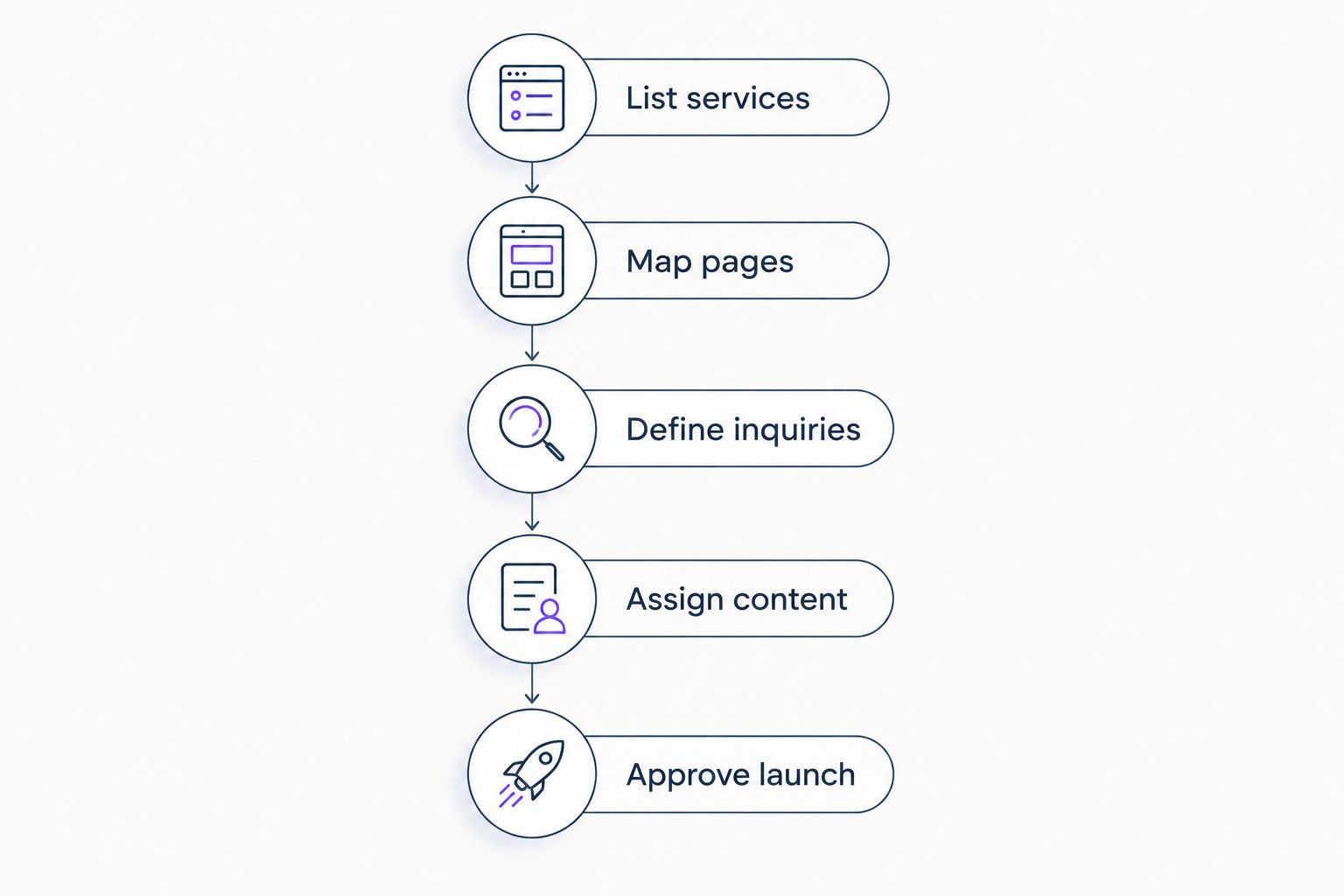
Then work through this sequence:
- List services. Identify the work you want the website to explain. Include emergency service only if your company actually offers it.
- Map pages. Assign each important customer question to a page. Avoid requesting pages that repeat the same message without adding useful information.
- Define inquiries. Decide whether visitors should call, request an estimate, or submit a service request. Describe what happens after submission.
- Assign content. Name who provides business facts, photos, copy, and approvals. Keep unsupported claims out of the draft.
- Approve launch. Require approval of the finished site and launch plan before changes reach the live website.
Give the same brief to every provider. You will get a clearer comparison than asking each one to interpret “a modern HVAC website” independently.
Keep the brief practical. You do not need to write a design manual. You do need to explain what you sell, where you work, and how a useful inquiry reaches your team.
What should your website quote include?
A usable quote names deliverables, responsibilities, exclusions, and approval points. It should let you answer a straightforward question: what exactly are you agreeing to buy?
Look for a page list, a description of content work, the required functionality, and a launch process. Ask how revisions are handled and how changes to the agreed scope are approved.
For a 2026 agreement, also ask who controls the domain, website account, and business-tool connections. Keep those responsibilities explicit rather than discovering them when you need an edit or a new provider.
Does an HVAC website quote include SEO?
An HVAC website quote includes only the search-related work named in the agreement. Ask the provider to distinguish launch setup from ongoing work such as writing additional content or managing a local search presence.
A promise that a site is “SEO-ready” does not tell you which tasks are included. Request the task list and the person responsible for each item.
Does a website rebuild include a new logo?
A website rebuild includes a new logo only when logo design is part of the agreed scope. Existing branding can be used, or branding work can be planned separately.
Settle that decision before approving the site design. Otherwise, you risk reviewing layouts built around brand assets you already intend to replace.
Choose help that matches the work
Moore Media Collective is best for trade business owners seeking website design alongside branding and social media management. Its stated services include logo design, branding, websites, and social media management for HVAC, plumbing, roofing, and landscaping companies.
Review the Moore Media Collective services against your brief. The relevant advantage is that those services sit within the agency’s stated offering; the boundary is that your proposal still needs to identify which work your project includes.
Do not treat a service list as a package agreement. Ask Moore Media Collective to document the deliverables, responsibilities, and approval process for your project. Require your approval before any changes reach your live website.
Define your HVAC website project
Describe your services, service area, and what needs to change before discussing the build.
Complete 4 launch checks before signing off
Approval should cover how the website works, not just how it looks. Use these checks on the version you are being asked to approve.
- Contact paths. Try the phone links and send a test inquiry. Confirm that the intended person receives the message and understands the requested service.
- Business facts. Check service descriptions, service areas, contact information, and any claims about credentials or emergency response. Publish only what your company can support.
- Mobile use. Read the key pages on a phone. Confirm that you can understand the service, find the next step, and complete the form without fighting the layout.
- Handoff. Confirm account access, maintenance responsibilities, and the process for requesting changes. Record who authorizes launch.
Make the launch approval explicit in your 2026 project plan. A draft link is for review; it is not permission to replace the live site.
FAQ
How much does a website cost for an HVAC company in 2026?
An HVAC website quote depends on the agreed design, content, functionality, and ongoing responsibilities. Request a written build scope and a separate breakdown of recurring obligations before comparing proposals.
Should I refresh my HVAC website or rebuild it?
Choose a focused refresh when you can name specific fixes and want to keep the rest of the site. Choose a rebuild when the structure, content, and design all need replacement; confirm the scope before approving either approach.
Do I need separate pages for furnace repair and AC installation?
Separate pages make sense when furnace repair and AC installation need different explanations and inquiry paths. Write each page around the actual service rather than repeating the same copy with a different heading.
Will a new HVAC website guarantee more booked jobs?
A new HVAC website does not guarantee more booked jobs. It should clearly explain your services and make contacting your company straightforward, while your team still needs to handle inquiries and book suitable work.
Who should own my HVAC company's domain and website accounts?
Your agreement should identify who controls the domain and website accounts and how your business accesses them. Confirm the handoff process before signing, including what happens if you change providers.
Can I keep my current site live while the new one is built?
Ask for a build and review process that keeps the current website live until you approve the replacement. Confirm the technical launch plan with your provider before work begins.
Does Moore Media Collective offer HVAC website design?
Moore Media Collective provides websites, logo design, branding, and social media management for HVAC and other trade companies. Confirm the specific deliverables and approval steps in your project proposal.
One last thing
Write the inquiry-handling plan before approving the contact form. Name who receives a service request, who checks it, and what your team does next. A working form is only part of the job; the handoff needs to work too.
Use that same discipline throughout the project. Buy named work. Approve clear deliverables. Keep control of your business accounts and your live-site approval.