
A plumber’s website redesign has no fixed turnaround: the launch date depends on the pages, content, technical work, and approvals included in your project. Get a written schedule tied to approved deliverables, not a blanket promise of a certain number of weeks. That schedule should include testing and launch approval—not just the day the new design looks finished.
- How long does a website redesign take for a plumber? Scope, content, testing, and approvals determine the schedule.
- Keep your current plumbing website live while the replacement is built and reviewed.
- Approve the page list before design starts; added pages need a revised schedule.
- Moore Media Collective fits plumbers seeking website design and branding services.
How long does a website redesign take for a plumber?
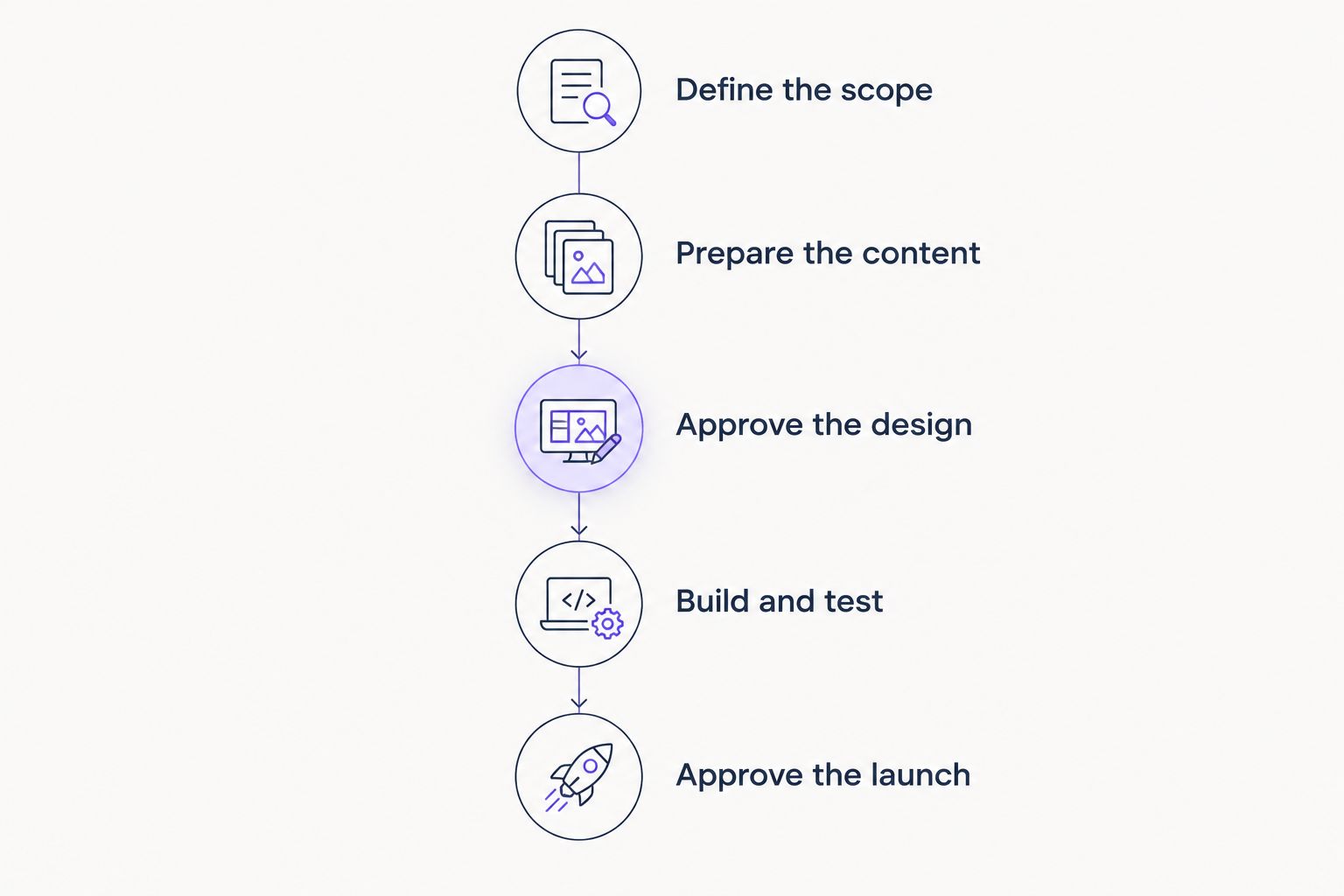
A useful redesign timeline follows the work from an agreed page list through an approved launch. Ask for dates attached to these steps in your 2026 proposal. A single delivery date hides too much.
If you are comparing website design services, ask each provider to explain what you must supply, what you must approve, and what happens when the scope changes.
Define the scope
Decide what the new website needs to do before discussing its launch date. For a plumbing business, that means identifying the services you actually offer, the areas you actually serve, and how customers should contact you.
Separate necessary work from optional additions. Replacing an outdated homepage is a different assignment from rewriting every service page, changing the logo, and connecting a booking system.
Approve the page list before design starts. Otherwise, neither you nor the designer has a clear finish line.
Prepare the content
Gather the material the designer needs: your business details, service descriptions, approved photos, logo files, and contact information. Check the facts yourself. A designer should not have to guess whether you handle sewer repairs or serve a particular suburb.
Write down any claims that need checking before publication. That includes licensing language, warranties, emergency-service promises, and financing information. Leave unsupported claims out rather than letting them become unfinished decisions near launch.
Approve the design
Review the proposed layout before it becomes the whole website. Start with the homepage and a representative service page. Check whether a homeowner can understand the service, confirm the service area, and find the next step.
Give one consolidated response. Contradictory messages from an owner, office manager, and outside adviser leave the designer without a clear instruction.
Approval should mean the direction is settled. New ideas after approval belong in a scope discussion, not an untracked stream of messages.
Build and test
The approved design still needs working pages, links, forms, and phone actions. Review the site on an actual phone, not just a desktop preview.
Submit a test inquiry and confirm it reaches the intended inbox. Check that the phone link uses the right number. If existing page addresses change, include a redirect plan rather than leaving old links without a destination.
Approve the launch
Give explicit approval before the replacement goes live. Confirm who controls the domain, who handles the release, and how the existing site will be restored if a launch problem requires it.
A finished preview is not permission to change your live website. Keep launch authorization separate from feedback on a draft.
Why this matters
Your plumbing website needs to help homeowners reach the right business, not become another job you manage between service calls. A clear schedule tells you when your attention is needed and what decision comes next.
For your 2026 redesign, judge progress by usable deliverables. A homepage mockup is progress. A tested request form is progress. An unexplained statement that the project is nearly done tells you little.
The business goal stays simple: make your services clear and make contacting you straightforward. A redesign supports that goal; it does not guarantee calls or booked jobs.
Which type of plumbing website redesign do you need?
Choose the smallest scope that fixes the actual problem. Do not approve a full rebuild simply because your current site looks dated. Equally, do not order a visual refresh when the service information and inquiry process also need work.
| Redesign scope | Best for | Main advantage | Main limitation |
|---|---|---|---|
| Visual refresh | Accurate content with an outdated presentation | Keeps attention on layout and appearance | Does not resolve missing content or broken workflows by itself |
| Content and layout redesign | Unclear services, weak page organization, or confusing contact steps | Addresses what customers read and how they move through the site | Requires factual input and content approval |
| Rebuild with system changes | A project that includes replacing the underlying site setup or connected tools | Addresses requirements beyond appearance | Adds technical decisions and testing responsibilities |
Visual refresh
A visual refresh fits a site whose information is already correct. You keep the useful material and improve how it is presented.
Its limit is straightforward: cleaner styling does not fix an incorrect service area, an abandoned form inbox, or missing service details. Confirm that the problem really is presentation before choosing this scope.
Content and layout redesign
A content and layout redesign fits a plumbing website that leaves customers with unanswered questions. You review the page structure and rewrite information alongside the design.
The trade-off is owner involvement. Someone who knows the business must confirm what the company does, where it works, and which claims are accurate. That responsibility cannot be handed off through a vague instruction to make the website better.
Rebuild with system changes
A rebuild fits work that reaches beyond page appearance. Examples include changing the website platform or introducing a different inquiry or booking workflow.
The benefit is addressing the underlying requirement. The drawback is additional access, setup, and testing work. Ask which existing functions will be retained, replaced, or removed before approving this scope.
Why a plumbing website redesign timeline varies
The calendar follows decisions and dependencies. These are the factors to settle in your 2026 project plan:
- Page scope. Confirm which pages need new layouts, new writing, or migration. A page title alone does not describe the work.
- Content readiness. Identify who supplies service details, photos, business information, and permissions to use customer material.
- Branding decisions. Settle whether the existing logo stays. A pending branding decision leaves related design choices unresolved.
- Technical connections. Name the forms, booking tools, domain access, and other connections included in the assignment.
- Approval responsibility. Assign someone who can resolve conflicting feedback and authorize the next stage.
- Changes after approval. Require a schedule update when you add services, pages, or functions outside the agreed scope.
You do not need to learn web development to control these factors. You need written responsibilities. Every unresolved item should have an owner and a next action.
What should you prepare before the redesign starts?
Create a shared project folder before the kickoff discussion. Keep the latest approved material together so nobody builds from an old attachment.
Include the following:
- Your correct business name and public contact details.
- A confirmed list of plumbing services and service areas.
- Logo files and photos you have permission to publish.
- Existing website access, shared through an appropriate secure method.
- The destination for website inquiries.
- Any business claims that require your confirmation.
Do not share passwords in an open document. Ask how access should be granted, and retain control of accounts your business depends on.
Then assign 1 project owner, 1 approved page list, and 1 launch approver. Those are recommended controls, not a staffing requirement. As an owner-operator, you can hold both decision-making roles; the point is removing ambiguity.
For local content, use places you genuinely serve. A Kansas City plumber should not approve pages for Omaha, Des Moines, Denver, or Chicago unless those locations are part of the business’s actual coverage.
How can you keep the redesign moving without cutting corners?
Make decisions earlier rather than skipping checks later. Approve the page list, provide accurate business information, and settle the contact workflow before treating the launch date as fixed.
Reserve time to review drafts. Send feedback that names the issue and the desired correction: the wrong service area, a missing phone action, or a service description that does not match your work. Instructions such as make it pop leave the actual decision unresolved.
Keep unrelated ideas separate. A new logo, social media templates, and extra landing pages can be valid projects. They should not silently become conditions for finishing an already approved website scope.
Moore Media Collective provides website design and branding for plumbing and other trade businesses. That makes the agency relevant when your project includes both; it does not replace the need for a written scope and approval plan.
Discuss your plumbing website redesign
Explain what needs to change and ask for a scope-based project schedule.
Can your current plumbing website stay live during a redesign?
Your current website can remain live while a replacement is built in a separate preview environment. Make that a written project requirement, and ask how access to unfinished pages will be restricted.
Do not replace a working site with a holding page just to show that construction has started. Customers still need accurate contact details and a way to request service.
Before your 2026 launch, confirm the release sequence. Know who approves it, who publishes it, and who checks the live site afterward. Treat any expected interruption as an explicit discussion, not an assumption.
What should you check before approving launch?
Open the preview as a customer would. Use your phone and follow the path from finding a service to making contact. Do not stop at whether the homepage looks better.
Check these items:
- Services: Every listed service matches work you actually accept.
- Coverage: Location names match your real service area.
- Contact: Phone actions and inquiry forms reach the correct destination.
- Content: Photos, testimonials, and business claims have approval for publication.
- Existing links: Changed page addresses have an agreed redirect plan.
- Access: Your business retains the account access it needs.
Record any unresolved issue before authorizing publication. Separate launch blockers from improvements that can be scheduled afterward, and agree on that distinction with the designer.
A useful launch check ends with a clear decision: approved, or not approved with specific corrections. Silence is not approval.
FAQ
How long does a website redesign take for a plumber in 2026?
A plumber’s website redesign follows the schedule agreed for its scope, content, technical work, and approvals. Ask for milestone dates covering design, build, testing, and launch rather than relying on a generic turnaround promise.
Can I get an exact launch date before the project starts?
You can request a target launch date before work starts, but it should come with a defined scope and stated dependencies. Confirm what happens to that date if content, access, or approvals remain unresolved.
Will my old plumbing website stay online during the redesign?
Your old plumbing website can stay online while a replacement is built separately. Put that requirement in writing and require explicit approval before the live website changes.
Does changing my logo affect the website redesign schedule?
Changing your logo adds a branding decision to the website project. Settle whether the new identity must be approved before the website design proceeds.
What should I send my website designer first?
Send accurate business details, your service list, service areas, approved images, and the intended destination for inquiries. Arrange secure access separately rather than putting passwords in an open project document.
Should I approve launch as soon as the design looks finished?
Approve launch only after reviewing the content and testing the contact path. A finished-looking preview does not prove that forms, phone actions, and changed page links work correctly.
Does Moore Media Collective work with plumbing businesses?
Moore Media Collective provides website design, branding, logo design, and social media management for plumbing and other trade businesses. Discuss the specific work you need before agreeing to a project schedule.
One last thing
Before signing a 2026 redesign proposal, ask this: What exactly will be ready for me to approve at each milestone? The answer should describe something you can inspect, not just activity happening behind the scenes.
Then ask what remains between design approval and launch. That question separates a good-looking draft from a working plumbing website. Keep the old site serving customers until the replacement has earned your approval.