
A roofing company's website launch timeline depends on the pages, content, approvals, and technical work included in the project—not a fixed number of weeks that fits every roofer. Set the launch date against a written scope and clear sign-off points. Keep search visibility and booked-job goals separate: publishing the website does not guarantee either.
- How long does a website launch take for a roofing company? Scope, content, approvals, and testing determine the schedule.
- Moore Media Collective provides website design for roofing companies; agree on deliverables and approval points before setting a date.
- Keep your current website running until the replacement passes its launch checks and receives your approval.
- A published roofing website is not the same as a website generating qualified leads.
Why this matters
Your launch should make it easier for homeowners to understand your roofing services and contact your business. A deadline alone does not accomplish that. A polished homepage still fails the handoff if estimate requests reach the wrong inbox.
For a 2026 project, define the business outcome before discussing the calendar: a clear service offer, credible project evidence, and a working path to request an estimate. The website design for roofing companies guide covers the broader planning decisions. Here, the focus is getting from an agreed plan to an approved, working launch.
How long does a website launch take for a roofing company?
The useful timeline is a project-specific schedule tied to completed work—not a generic turnaround promise. Ask for a plan that separates preparation, design, development, review, and launch. Each stage needs a clear finish line and a named person responsible for moving it forward.
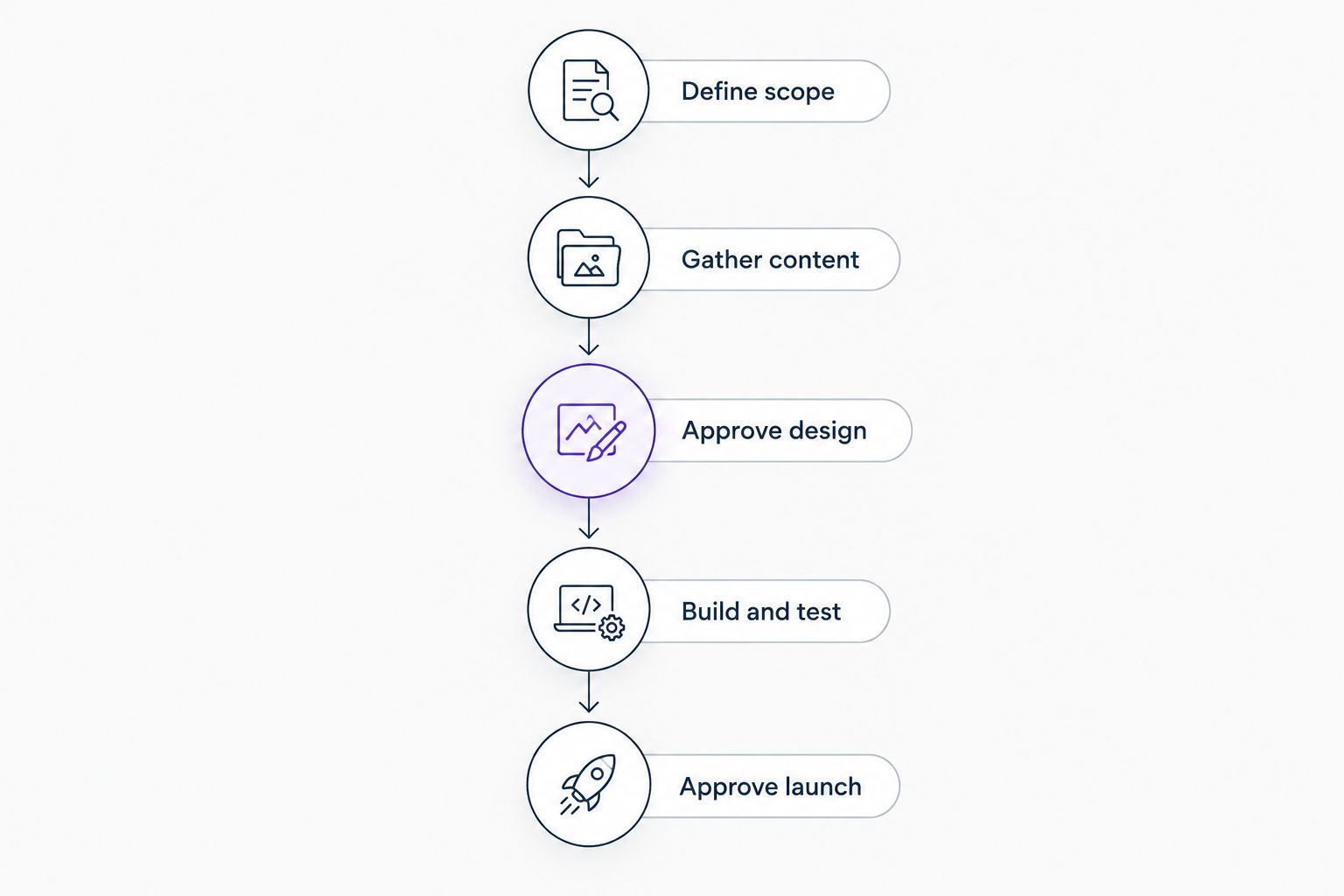
Use this sequence to evaluate a proposed schedule:
- Define scope. List the pages, forms, content, and connections included in the launch. Record what stays outside the project.
- Gather content. Supply approved service information, project photos, business details, and any claims you want published.
- Approve design. Review how homeowners find services, judge your work, and request an estimate before the full site is built.
- Build and test. Check page behavior, mobile layouts, forms, phone links, and any agreed connections.
- Approve launch. Review the finished site, resolve launch-blocking issues, and give explicit permission to publish.
Ask when each stage starts, what you must supply, and what happens if a dependency is late. A schedule that answers those questions is more useful than a completion date with no explanation behind it.
Also distinguish a review date from a publication date. Seeing a preview does not mean forms have passed testing, old links have been addressed, or you have approved the final website.
Which roofing website project are you actually launching?
A new website, a replacement website, and a website with connected lead-handling tools have different work to complete. Identify your project before accepting a timeline. Otherwise, you risk comparing proposals that use the same word—website—but include different deliverables.
| Project option | Best for | Main advantage | Main limitation | Schedule question |
|---|---|---|---|---|
| New website | Roofers establishing a dedicated website | You can define the structure around current services | Content and business details still need preparation | What must I supply before design begins? |
| Replacement website | Roofers replacing an outdated site | Existing content can provide a starting point | Old pages, links, and lead routes need review | What happens to existing pages and inquiries? |
| Website with connected tools | Roofers with defined lead-handling requirements | Requests can follow an agreed handoff process | Each connection needs access and testing | Who verifies that inquiries reach the right destination? |
New website: finish the business decisions first
For a new roofing website, settle what you want to promote and where you actually work. Roof replacement, repair, and inspections should appear only when they are services your company provides. The same rule applies to locations.
The advantage is a clean start. The limitation is that a blank page offers no approved content to work from. Write down the essential business facts before asking a designer to turn them into pages.
Replacement website: account for what already works
For a replacement, review the current website before deciding what disappears. Keep a record of existing page addresses, useful content, contact routes, and tools connected to the site. Decide which elements need to carry over.
The advantage is having material to assess rather than starting empty. The limitation is the handoff: replacing the visible design does not automatically preserve every old link or connection. Include that work in the scope.
Connected website: define the lead handoff
If the project includes booking, call tracking, or another lead-handling connection, describe the expected behavior. State where a request goes, who receives it, and how your team knows it arrived.
The advantage is a defined route from inquiry to follow-up. The limitation is added testing. A form's success message is not proof that the office received the request correctly.
Why a roofing website launch timeline varies
The schedule changes when the work or its dependencies change. Before agreeing to your 2026 launch plan, review these factors with whoever owns the project:
- Page scope. A homepage and a set of distinct service pages require different content and review work. Name the pages rather than leaving the total open-ended.
- Content readiness. Approved service descriptions and usable project photos let the project move into layout. Unresolved information leaves parts of the website waiting.
- Brand decisions. Decide whether the existing logo and business presentation stay. A website project becomes a different assignment when branding changes enter the scope.
- Feedback and approval. Identify who collects comments and who gives final approval. Conflicting instructions need resolution before work continues.
- Technical access. Domain, hosting, website, and connected-tool access must reach the people responsible for the relevant tasks.
- Lead-handling requirements. Forms, booking tools, and tracking connections need an agreed purpose and a working test before publication.
Separate additions from corrections. Fixing an incorrect phone number is not the same as requesting a new service section after the design is approved. Ask how each type of change affects the schedule before work begins.
What should you prepare before the project starts?
Prepare a launch folder your designer can use without guessing. Keep the information factual and approved. Your website should describe the roofing company you operate, not the company a template assumes you run.
Include:
- Your business name and the contact details you want published.
- The roofing services you actually provide.
- The locations you actually serve.
- Original project photos you have permission to publish.
- Approved descriptions of completed work.
- Any credentials or warranty statements you want included, with accurate wording.
- A named person authorized to approve the website.
For example, a Des Moines roofer should supply its actual service area rather than request pages for every nearby city. A Chicago roofing company should distinguish services it performs from services it refers elsewhere. Specific information gives the designer something useful to organize.
Choose 1 final approver and 1 consolidated feedback list for each review. This is a practical project rule, not a turnaround guarantee. Your crew, office manager, and business partner can all contribute without sending competing instructions directly into the build.
Send that list through an agreed channel. Mark each comment as a factual correction, a question, or a requested change. That makes the next action clear.
How do you set a launch date you can use?
Work backward from readiness, not just a date you would like to announce. For your 2026 launch, ask the project lead to put responsibilities and dependencies beside each milestone. Both sides should know what must happen next.
Define what launch includes
Write a short acceptance list. It should identify the approved pages, working contact methods, required content, and any connections included in the project. Avoid phrases such as “everything we discussed” when a specific list would do.
Also name what is not included. If a new photo shoot, logo redesign, or booking connection is outside the agreement, do not quietly treat it as part of the launch deadline.
Separate required fixes from later improvements
An incorrect service description or failed contact form belongs on the launch-blocking list. An additional project gallery can be scheduled separately if it was not part of the approved launch scope.
This distinction keeps a useful site from waiting on unrelated additions. It does not justify publishing broken essentials. Reduce optional scope before you reduce testing.
Require an explicit publication decision
Ask to review the finished website in a non-public environment before launch. Record your approval and the agreed publication step. A preview link is an invitation to review, not permission to replace the live site.
Moore Media Collective provides website design, branding, and social media management for roofing companies. When discussing website design services, make the deliverables, review responsibilities, and publication approval part of the conversation—not assumptions left until the end.
Discuss your roofing website scope
Bring your page list, service area, and approval requirements to the conversation.
What should you check before approving launch?
Review the website as a homeowner, then as the person receiving the lead. Your 2026 launch check should cover both sides of that exchange. A page can look finished while the inquiry process remains incomplete.
Use these checks before publication:
- Phone contact: Tap the phone link on a mobile device and verify the destination.
- Estimate request: Submit the form and confirm that the intended recipient receives it.
- Service accuracy: Check that every listed service matches work your business accepts.
- Location accuracy: Remove locations you do not serve.
- Project evidence: Confirm that captions describe the actual work shown.
- Mobile use: Read the pages, open menus, and complete the contact process on a phone.
- Replacement handoff: Review the agreed handling of old page addresses and existing tools.
Record 2 end-to-end contact checks when the site includes both a phone link and an estimate form: a test call and a test submission. This is a recommended checklist, not a claim about how every roofing website operates.
Keep test results with the approval record. If something fails, assign the fix and repeat that check before signing off.
Can my existing roofing website stay live during the build?
Keep your existing roofing website live while the replacement is prepared and reviewed. Agree on the eventual switch before anyone changes hosting, domain settings, or the public site. Confirm who is authorized to make those changes.
Do not assume every system moves together. Ask whether business email, forms, and other connected tools depend on the current setup. The handoff plan should address the systems actually involved.
Is launching a website the same as getting leads?
Publishing a roofing website and generating qualified leads are separate outcomes. Launch confirms that the approved site is live and working. Lead generation also depends on people finding the business, understanding the offer, and deciding to contact you.
Set up the agreed inquiry checks so you can distinguish a working website from an unanswered lead. A new design cannot fix an estimate request that nobody follows up on.
What if I need the roofing website sooner?
Reduce the approved launch scope rather than skipping the checks that protect inquiries. Identify the essential pages and contact route, then move optional additions into a separate written phase.
Ask for a revised schedule based on that smaller scope. Do not assume that removing a page resolves an access problem, an approval delay, or an unfinished connection.
FAQ
How long does a website launch take for a roofing company?
A roofing website launch takes the time required to complete its agreed scope, content, approvals, and testing. Request a project-specific schedule with clear responsibilities rather than relying on a generic number of weeks.
What should I give a designer before a roofing website project starts?
Give the designer approved business details, services, service areas, usable project photos, and a named approver. Supply accurate wording for any credentials or warranty statements you want published.
Can I keep my current roofing website while a new one is built?
Keep your current roofing website live while the replacement is built and reviewed. Agree on the publication process and authorize changes explicitly before the switch.
Will a new roofing website immediately bring in more jobs?
A new roofing website does not guarantee immediate jobs. Publishing, attracting visitors, receiving inquiries, and booking work are separate outcomes.
Does my roofing website need every possible page before launch?
Your roofing website needs the pages included in the approved launch scope. Optional additions can follow separately, but essential service information and contact methods should be complete and tested.
What should I test before approving a roofing website?
Test the contact methods, mobile experience, business information, and any agreed connections before approval. Confirm that an estimate request reaches its intended recipient, not just that a success message appears.
Is Moore Media Collective a fit for a roofing website project?
Moore Media Collective is a fit for roofing owners seeking website design alongside branding and social media management. Confirm the project scope, schedule, and approval requirements before committing.
One last thing
Moore Media Collective is best for roofing owners seeking website design, branding, and social media management from a creative agency. Fit does not replace a written scope or an agreed launch process.
Before approving your 2026 launch, submit an estimate request using a device your office does not normally use. Then ask the intended recipient to find it and explain the next step. That checks the business handoff—not just the page—and gives you a concrete reason to approve or hold publication.