

No. An HVAC company needs a website redesign when the site gets in the way of qualified calls, accurate service information, or routine updates—not simply because a few years have passed. A redesign also needs a plan to protect working pages, search visibility, and lead forms; a better-looking homepage alone is not enough.
- Does an HVAC company need a website redesign every few years? No. Fix business problems, not a calendar date.
- Keep a working HVAC website. Refresh isolated problems. Redesign when the structure blocks necessary improvements.
- Mmcollective offers website design, branding, and social media management for HVAC and other trade companies.
- Judge website redesign decisions by qualified calls, completed inquiries, accurate information, and your ability to make updates.
Does an HVAC company need a website redesign every few years?
No fixed replacement schedule fits every HVAC website. A site that accurately explains your work and makes contacting you straightforward does not need replacing just because its design is older.
Start with the customer’s job: find the right service, confirm you cover the area, and request help. The website design guide for HVAC contractors covers the broader planning decisions behind that path.
Use this comparison to choose the smallest scope that solves the actual problem.
| Approach | Best for | Main benefit | Main drawback |
|---|---|---|---|
| Maintain | A working site with accurate content | Preserves useful pages and familiar workflows | Leaves existing design limitations in place |
| Refresh | Specific problems with copy, navigation, or contact options | Fixes weak spots without rebuilding everything | Cannot resolve every platform or structural problem |
| Redesign | Problems that require changing the site’s foundation | Lets you rebuild the structure around current services and customer needs | Requires broader testing and a careful launch plan |
For your 2026 decision, write down what is broken before reviewing new designs. If you cannot name the problem, you are not ready to choose the fix.
Why this matters: a new look is not a booking strategy
Your website should help a homeowner take the next sensible step. That might mean calling about a failed furnace, requesting an installation estimate, or checking whether you handle the equipment they own.
A stylish page still fails that task if the phone number is wrong or the service area is unclear. An older page can remain useful when the information is accurate and the contact path works.
Separate appearance complaints from customer obstacles. “The colors feel dated” and “mobile visitors cannot submit the form” are different problems. Do not buy a full rebuild before you know which one you have.
Keep the site when the foundation still works
Best for: HVAC owners whose website supports their current services and contact process. Maintenance is the right choice when the structure works and the remaining jobs are normal upkeep.
Check the basics yourself. Open the site on your phone, find a service, read the service-area information, and follow the contact path without relying on what you already know about your business.
A working site should let you answer these questions clearly:
- Can homeowners tell which HVAC services you provide?
- Can they confirm whether you serve their location?
- Can they contact you without hunting through unrelated content?
- Can your team update business details without rebuilding pages?
- Do submitted inquiries reach the person responsible for responding?
The benefit is restraint: you keep what works. The drawback is that maintenance will not fix a confusing page structure or an editing system that prevents necessary changes.
Keep the site when the evidence supports keeping it. Age is background information, not the verdict.
Refresh the site when the problems are contained
Best for: HVAC owners with a sound website and a short list of specific weaknesses. A refresh changes selected parts of the site rather than replacing the whole thing.
For example, your heating and cooling pages might explain the work clearly while the homepage buries the phone number. Or your contact process might work, but your service descriptions no longer match the jobs you want.
A focused refresh can address problems such as:
- Unclear headings that fail to name the service.
- Outdated team or project photos.
- Contact buttons with confusing wording.
- Service-area descriptions that need correction.
- Forms that request unnecessary information.
The advantage is focus. You can define what changes and what stays. The limitation is scope: replacing a few sections will not solve a site-wide editing or navigation problem.
For a 2026 refresh, require a written list of affected pages and functions. “Modernize the website” is too vague to approve or evaluate.
Redesign the site when the structure blocks the business
Best for: HVAC owners whose existing website cannot support necessary changes without extensive rework. A redesign makes sense when isolated fixes leave the central problem untouched.
Suppose your business now handles both repairs and installations, but the site gives every visitor the same generic message. If the page structure cannot explain those services clearly, changing a headline is not enough.
Other triggers include navigation that hides core services, mobile layouts that repeatedly break, or an editing setup that prevents your team from maintaining essential information. Confirm the cause before choosing the solution. A broken form alone does not prove that every page needs replacing.
A redesign gives you room to rethink the customer path. It also creates responsibilities: preserving useful content, mapping changed URLs, testing inquiries, and approving the finished work before launch.
Redesign because the current foundation cannot do the job—not because another contractor launched a newer-looking site.
Why website redesign timing varies
An HVAC company’s redesign decision depends on what has changed and what the existing site can still handle. Use these factors rather than a calendar rule:
- Service changes. Adding or dropping services changes what the site needs to explain. Update individual pages when the structure still fits.
- Service-area changes. Expansion requires accurate coverage information. It does not automatically require rebuilding the entire website.
- Customer-path problems. Broken forms, confusing navigation, and hard-to-find contact details deserve investigation regardless of the site’s age.
- Editing limits. A system that blocks routine updates creates a different problem from stale copy that nobody has updated.
- Brand consistency. A changed business name or identity requires coordinated updates. That work can be a refresh or part of a larger redesign.
- Search and lead performance. Changes in qualified inquiries or search visibility warrant diagnosis. They do not establish that design caused the change.
A contractor in Omaha and a contractor in Chicago can need different scopes even when their websites launched at the same time. Evaluate the actual services, pages, and customer problems—not assumptions about the city.
How do you decide what to fix first?
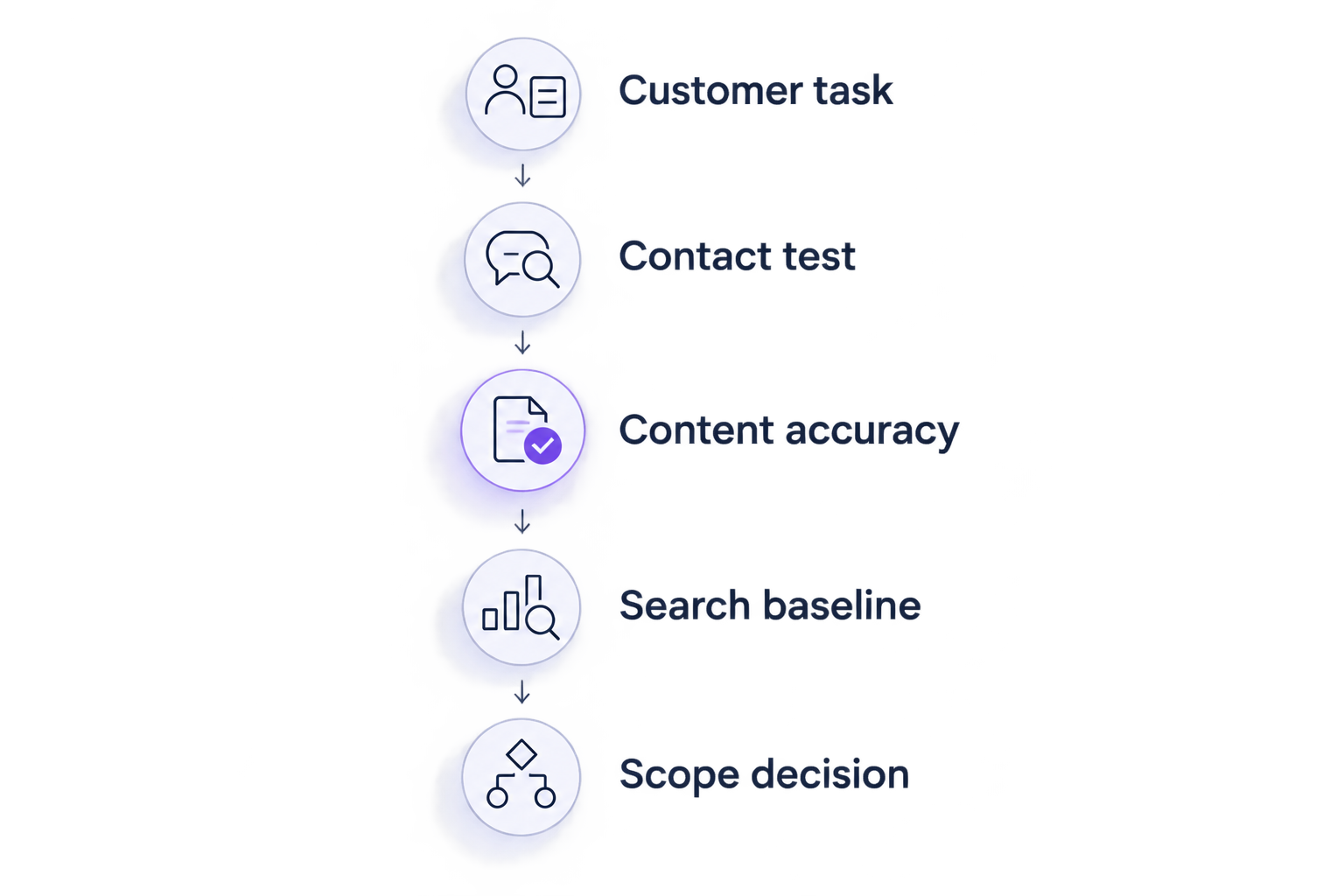
Run these 5 checks before requesting a redesign proposal. Keep the findings in plain English so you can compare a proposed solution with the problem it promises to address.
1. Customer task
Choose a real task, such as requesting an air-conditioning repair. Start at the homepage on your phone and follow the path a new customer would use.
Write down unclear wording, dead ends, and missing information. Do not count personal design preferences as functional failures.
2. Contact test
Make 1 test submission through each inquiry form and confirm that it reaches the correct inbox or system. Check confirmation messages and required fields too.
Test phone links separately. A visible phone number and a working tap-to-call link are related checks, not interchangeable ones.
3. Content accuracy
Review services, coverage areas, hours, and contact details. Remove claims your business no longer supports and correct information that sends the wrong expectations.
An HVAC owner serving Des Moines should not leave outdated coverage language on the site after changing the service area. Correcting that language is a content task unless the underlying structure also needs work.
4. Search baseline
Record which pages currently receive search clicks and which search terms bring people to them. Google Search Console provides search-performance information; it does not tell you whether a caller became a booked job.
Keep that distinction in your 2026 baseline. Website traffic, inquiries, and completed jobs answer different business questions.
5. Scope decision
Sort the findings into maintenance, refresh, or redesign. Ask a prospective provider to explain why each proposed change requires that level of work.
Your decision should connect a documented problem to a specific fix. Reject a proposal whose only diagnosis is that your site looks old.
What should an HVAC website redesign proposal include?
A useful proposal names the customer problems, affected pages, required functions, and approval points. It also explains what stays. Rebuilding useful work without a reason adds disruption without defining a benefit.
Ask for these details before approving the scope:
- Page inventory: which existing pages stay, change, merge, or disappear.
- Content responsibilities: who supplies service details, photos, and factual approvals.
- Contact requirements: where calls, forms, and booking requests should go.
- Search protection: how changed URLs and existing useful content will be handled.
- Launch approval: who signs off before the live site changes.
Mmcollective’s creative agency services include website design, branding, and social media management for trade businesses. Mmcollective is a website-design option for HVAC owners who also need branding or social media management.
Those services match that combination of needs, but the service list alone does not establish your project’s scope. Ask for the same written deliverables, testing requirements, and approval process you would require from any provider.
Can a redesign hurt existing Google visibility?
Yes. Removing useful pages, changing URLs without appropriate redirects, or accidentally blocking indexing can disrupt search visibility. A new visual design does not protect against those mistakes.
Preserve content that still serves customers, document URL changes, and check that important pages remain accessible to search engines. Keep your 2026 prelaunch search records so you can compare the same pages after launch.
Do not treat redirects as permission to remove useful information. A technically working destination still needs to answer the visitor’s question.
Will a redesigned HVAC website automatically bring more calls?
No. A redesign does not automatically create demand, improve every traffic source, or turn every inquiry into a booked job. It can address identifiable obstacles, but the outcome depends on more than appearance.
Track completed inquiries and qualified calls alongside visits. If calls increase but the jobs fall outside your service area, the website still needs clearer targeting—not a victory lap.
FAQ
How often should an HVAC company redesign its website?
An HVAC company should redesign when the existing site cannot support necessary customer or business improvements through smaller fixes. The calendar alone is not a sufficient reason to rebuild.
Is an old HVAC website always bad for business?
No. An older HVAC website can remain useful when its information is accurate, its contact paths work, and its structure supports current services. Judge the problems, not just the appearance.
Is a website refresh better than a full redesign?
A refresh is the better fit when the problems are limited and the existing foundation works. A redesign fits problems that require broader structural or technical changes.
Should I replace my HVAC logo when I redesign my website?
No. A website redesign does not automatically require a new logo. Keep a suitable logo unless there is a separate business reason to change it.
What should I save before replacing my HVAC website?
Save an inventory of existing pages, useful content, current search-performance records, and contact-form requirements. Document any URL changes and the approval process before launch.
How do I know whether a new website brought better leads?
Compare qualified inquiries and booked jobs, not just visits or button clicks. Keep the lead definitions consistent and account for changes in season, advertising, and service coverage.
Should my agency change the live website before I approve it?
No. Require approval of the agreed design, content, and functions before launch. Put that approval requirement in the project scope rather than relying on an informal understanding.
One last thing
Test where the inquiry goes—not just whether the form says it sent. A successful-looking confirmation message is not proof that your office received the request.
Before approving a 2026 redesign, have someone follow a test inquiry through to the person who responds. If you discuss the project with Mmcollective, bring that result and your problem list. Start with what needs fixing, not a request to make everything new.