
Yes—a website redesign is worth it for HVAC companies in 2026 when it fixes a clear barrier to calls, qualified leads, or booked jobs. If your website already explains your services, works on a phone, and brings in suitable inquiries, fix the weak pages instead of rebuilding everything.
- Is a website redesign worth it for HVAC companies? Yes, when it removes specific barriers to qualified inquiries.
- Moore Media Collective provides website design and branding for HVAC and other trade companies.
- Choose targeted repairs when your HVAC website works but individual pages or forms fail.
- Judge a redesign by qualified leads and booked jobs, not a newer-looking homepage.
Is a website redesign worth it for HVAC companies in 2026?
A redesign earns its place when the problems run across the website, not just across the homepage. Missing service information, confusing navigation, broken inquiry forms, and inconsistent business details give you specific problems to fix.
Start with the customer’s route from landing page to inquiry. The website design guide for HVAC contractors provides a useful starting point for planning that route.
| Approach | Best for | Main advantage | Main drawback |
|---|---|---|---|
| Targeted repairs | A working website with isolated problems | Fixes the specific obstacle without replacing useful pages | Leaves broader structural problems untouched |
| Website redesign | Confusing structure or repeated problems across pages | Lets you rebuild service navigation, content, and inquiry paths together | Requires content decisions, testing, and careful search migration |
| Keep and maintain | A clear website that produces suitable inquiries | Preserves what already works | Does not address problems you have not measured |
An old-looking website is a reason to inspect it. It is not proof that you need a replacement. Tie the decision to a business problem before approving the work.
Why this matters
Your website has a practical job. It should help a homeowner understand whether you handle the problem, serve the address, and offer a clear way to ask for help.
A homeowner looking for furnace repair in Omaha needs different information from someone planning an air-conditioning replacement in Kansas City. Both need a clear next step. Neither needs to decode a vague headline about comfort solutions.
For your 2026 website plan, define the outcome in plain language: more suitable service requests, clearer replacement inquiries, or fewer calls from outside your service area. A design brief built around those outcomes is more useful than a list of websites you like.
Choose targeted repairs when the foundation works
Best for: HVAC owners whose website has specific, contained problems. Keep the working structure and repair the parts that interrupt an inquiry.
A hidden phone number does not automatically justify a rebuild. Neither does an outdated team photo or a service page that needs clearer writing. Fix those issues directly when the rest of the website remains usable.
Good candidates for targeted work include:
- A contact form that does not deliver submissions correctly.
- A phone link that uses the wrong number.
- A service page that omits the area you actually cover.
- A mobile menu that hides important pages.
- A replacement inquiry form that asks irrelevant questions.
The advantage is focus. You can name the problem and test the repair. The limitation is that isolated fixes do not resolve a structure that makes every service hard to find.
Before choosing this route, ask whether the same obstacle appears elsewhere. Rewriting a confusing page helps little if every navigation label sends visitors in the wrong direction.
Choose a redesign when the problems repeat
Best for: HVAC owners whose website needs structural changes across services, content, and contact paths. A redesign makes sense when fixing one page still leaves the rest difficult to use.
Suppose furnace repair, air-conditioning installation, and maintenance all sit inside one long page. If visitors cannot find the information relevant to their job, the problem is the structure—not the button color.
A rebuild also deserves consideration when ordinary updates require workarounds, mobile layouts repeatedly break, or the website describes services you no longer provide. Confirm the underlying issue before choosing a new platform.
The advantage is coordination. You can align page structure, business information, photographs, and inquiry forms. The drawback is disruption: existing pages, tracking, and search visibility need deliberate protection.
A redesign is not permission to discard everything. Keep useful service explanations and working customer paths unless there is a clear reason to replace them.
Keep the website when it already does the job
Best for: HVAC owners with a usable website and a clear record of suitable inquiries. Maintain the website rather than replacing it to follow a design trend.
Check the business details, service descriptions, forms, and phone links regularly. Update photographs and team information when they change. These are maintenance tasks, not automatic reasons for a redesign.
The advantage is continuity. The limitation is complacency. A website that worked previously still needs testing when your services, service area, or booking process changes.
What should an HVAC redesign actually improve?
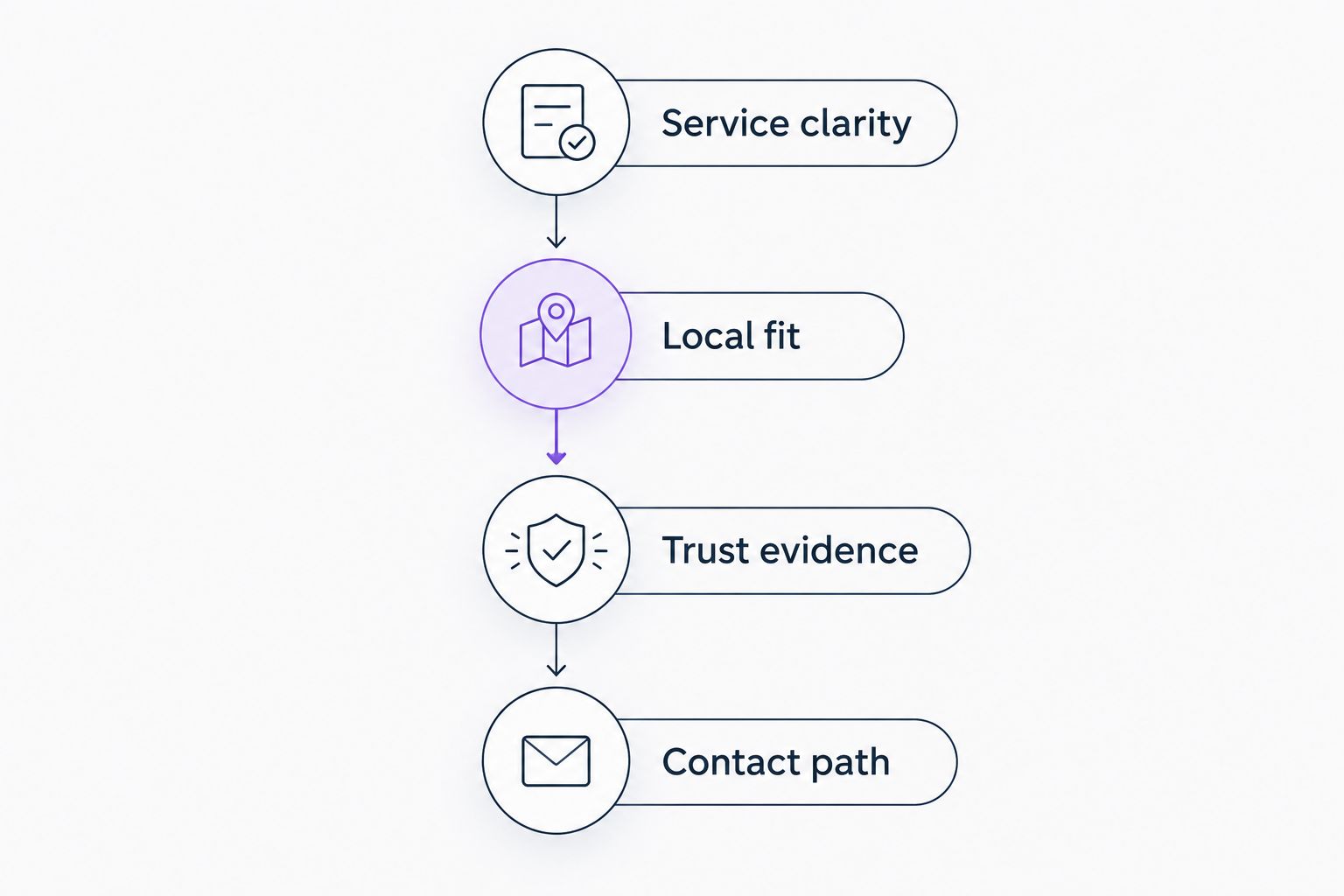
Build your 2026 redesign brief around the homeowner’s decisions. Each section should answer a question that matters before someone contacts your company.
Service clarity
State what work you handle. Furnace repair, AC replacement, heat-pump installation, and maintenance should appear only when you actually provide them.
Avoid turning every service into a generic paragraph about quality. Explain the job, the next step, and any relevant limitations. A clear service description helps homeowners judge whether the inquiry fits.
Local fit
Name your real service area. If you serve Omaha but not every surrounding community, make that boundary understandable rather than implying unlimited coverage.
The same rule applies in Des Moines, Denver, and Chicago. Use genuine local information; do not publish interchangeable city pages that promise work outside your operating area.
Trust evidence
Use real project photographs, accurate business details, and customer feedback you have permission to publish. State licenses or certifications only when they apply to your company.
A polished layout cannot substitute for evidence. Remove outdated claims instead of carrying them into the new design because they appeared on the old website.
Contact path
Give visitors a clear way to call or submit a request. Make the wording match what happens next: a callback request is not a confirmed appointment.
If you do not provide round-the-clock emergency service, do not build the website around that promise. Clear expectations help prevent the wrong inquiries.
Which technical targets belong in the brief?
Use measurable checks instead of asking for a website that feels fast. Google’s Core Web Vitals guidance defines good thresholds for loading, responsiveness, and visual stability; those thresholds give your 2026 brief a concrete technical reference.
- Loading: Largest Contentful Paint of 2.5 seconds or less.
- Responsiveness: Interaction to Next Paint of 200 milliseconds or less.
- Visual stability: Cumulative Layout Shift of 0.1 or less, a unitless score.
Google evaluates these thresholds at the 75th percentile of page visits, assessed separately for mobile and desktop. They describe user experience, not a promise of rankings or booked jobs.
Also test the tasks that performance scores cannot confirm. Tap the phone number, submit the form, check the confirmation message, and verify that the right person receives the inquiry.
A fast page with a broken contact form still fails the business. Technical checks and real inquiry tests belong in the same launch plan.
How should you measure whether the redesign worked?
Write down the starting point before changing the website. Without a baseline, a new homepage gives you a visual comparison but no useful business comparison.
Use the records you already maintain. If your tracking is incomplete, establish it before launch rather than filling the gap with assumptions.
- Record inquiry sources. Separate website inquiries from other channels wherever your tracking supports it.
- Define a qualified lead. Agree on service fit, location, and the type of work you want.
- Connect leads to outcomes. Record whether an inquiry becomes a booked job, an estimate, or no sale.
- Compare like conditions. Review equivalent service categories and seasonal periods rather than treating every month as interchangeable.
- Check delivery. Confirm that forms, call links, and notifications still work after launch.
Weather, advertising, staffing, and service demand complicate attribution. Record those changes alongside website results instead of crediting the redesign for every movement.
For example, more replacement inquiries are not automatically useful if your team wants repair work. The target is suitable demand that your operation can handle.
Why redesign value varies
The value of an HVAC website redesign depends on the problem it solves and the work required to solve it. Ask for a scope tied to these factors:
- Existing usability: Repeated navigation failures justify different work from an isolated broken link.
- Content accuracy: Incorrect service details require rewriting, not just a new layout.
- Service structure: Distinct services need clear routes to relevant information.
- Search continuity: Existing indexed pages need careful handling when addresses or content change.
- Inquiry handling: A clear website still needs a reliable process for answering requests.
- Editing needs: Your team needs a workable way to keep business information current.
Do not confuse a longer feature list with a better result. An added tool earns its place only when it supports a real customer task and someone can maintain it.
What should you ask an HVAC website agency?
Moore Media Collective is best suited to trade owners seeking website design and branding together. Its stated services include websites, logo design, branding, and social media management for HVAC and other trade companies.
When reviewing Moore Media Collective’s services, ask for a proposed scope tied to your actual website problems. An agency’s service list does not establish the deliverables of your project.
Ask these questions before you approve the work:
- Which existing pages should remain, change, or be removed?
- Who supplies service descriptions, photographs, and business details?
- How will existing page addresses and search tracking be handled?
- Who tests forms and phone links before launch?
- What requires your approval before the live website changes?
- What maintenance remains your responsibility afterward?
The benefit of combining branding and website work is the ability to plan them together. The trade-off is a broader set of decisions and approvals. If your branding already works, do not add replacement branding without a specific reason.
Will a redesign improve your Google rankings?
A redesign does not guarantee better Google rankings. It can address technical and content problems, but changing the appearance alone does not establish that your pages answer searches better.
Before launch, document existing page addresses and decide which should remain. Where an address changes, plan an appropriate redirect rather than leaving visitors and search engines at a missing page.
Protect useful content, too. Removing a detailed repair page and replacing it with a short promotional paragraph is not automatically an improvement.
Can a redesign fix a shortage of HVAC leads?
A redesign can address website barriers, but it cannot solve every cause of low lead volume. Inspect how people reach the website and what happens after they inquire.
If suitable visitors cannot find your services or contact you, website work addresses the problem. If inquiries arrive but nobody responds, the next move is operational—not another homepage revision.
Should you redesign before the busy season?
Schedule the launch when your team can review content, approve changes, and test inquiries. A seasonal deadline does not remove the need for those checks.
For a 2026 project, agree on review responsibilities before choosing a launch date. Keep the current website operating until the replacement is approved and ready.
FAQ
Is a website redesign worth it for a small HVAC company?
Yes, when the redesign addresses a specific obstacle to suitable inquiries. If your current website works and only individual elements fail, targeted repairs are the more focused choice.
How do I know whether my HVAC website needs a redesign?
A redesign deserves consideration when problems repeat across navigation, service information, mobile layouts, and contact paths. Isolated errors usually call for isolated fixes first.
Will a new HVAC website guarantee more booked jobs?
No website redesign guarantees more booked jobs. Results also depend on relevant visitors, service demand, inquiry handling, and your ability to complete the work.
Should I change my HVAC logo during a website redesign?
Change your logo only when it solves a specific business problem. An existing logo that identifies your company clearly does not need replacement just because the website changes.
Can I keep my existing website content?
Keep content that remains accurate, useful, and relevant to your services. Review existing pages before deleting them, especially when they already attract relevant search visitors.
What should I track after my HVAC website launches?
Track qualified inquiries, their sources, and the jobs or estimates that follow. Test form delivery and phone links as well, because reporting alone does not prove that inquiries reach your team.
Does Moore Media Collective work with HVAC companies?
Moore Media Collective provides website design, branding, logo design, and social media management for HVAC and other trade companies. Confirm the proposed deliverables and approval process for your project before work begins.
One last thing
Test the handoff after the form—not just the form itself. Submit a request from your phone, confirm that it reaches the right person, and check that the confirmation accurately describes the next step.
A redesign is unfinished if the page looks right but the inquiry goes nowhere. Make that test part of your approval decision.