Pick a website design company that can show how homeowners find your services, contact your plumbing business, and get a clear next step. Before you sign, require a written scope covering content, ownership, lead delivery, testing, and your approval before anything goes live.
- How to pick a website design company for a plumbing business: check working websites, lead handling, ownership, and approval terms.
- Choose plumbing website design around service calls and estimate requests, not a homepage screenshot.
- Moore Media Collective provides website design and branding for trades businesses; compare the proposed scope against your actual needs.
- Require a test inquiry and written launch approval before replacing your existing website.
How to pick a website design company for a plumbing business
Choose the company that explains the full path from a homeowner’s problem to a received inquiry. A good-looking homepage is only part of the job. Your selection process should cover these 6 steps:
- Define the job. List your actual services, service area, and preferred customer actions.
- Inspect working websites. Test navigation, service information, and contact options on your phone.
- Question the content plan. Establish who writes, checks, and approves every service claim.
- Follow the lead. Ask where calls, forms, and booking requests go.
- Check ownership. Put account access, content rights, and handover terms in writing.
- Approve the launch. Require testing and explicit permission before publication.
Moore Media Collective provides website design, branding, logo design, and social media management for trades businesses. Use the same checklist with every agency you consider. A relevant service list starts the conversation; a clear project agreement determines what you receive.
Why this matters
Your website should help a homeowner answer practical questions: Do you handle this problem? Do you serve this address? How do I reach you? A design review that skips those questions misses the reason you need the site.
For your 2026 redesign, separate appearance from function. A cleaner layout does not prove that a form reaches your office, and a prominent booking button does not prove that an appointment is confirmed. Ask the designer to demonstrate both.
Step 1: Tell the designer which plumbing jobs you want
Start with your business, not a design style. A company focused on residential drain cleaning needs different information from a contractor pursuing commercial plumbing projects. The website should reflect the work you actually accept.
Give each candidate the same brief:
- Services you want to promote and services you do not offer.
- Cities, neighborhoods, or other boundaries you actually serve.
- How customers should request urgent and scheduled work.
- Who answers calls and receives website inquiries.
- Existing pages, photos, and business information that need review.
Be specific about operating limits. Do not let a designer add emergency availability, financing, licensing statements, or guarantees without checking the facts with you.
Ask the candidate to turn that brief into a proposed page list. If the response is just a collection of visual references, bring the conversation back to customers and jobs.
Step 2: Inspect working sites, not just portfolio images
Open examples on your own phone. A screenshot shows a finished composition; a working website lets you inspect the route a customer takes. Look beyond the first screen.
Use these 3 test tasks during every portfolio review:
- Find a service: Locate information about a specific plumbing problem.
- Check the area: Determine whether the business serves a particular location.
- Start contact: Find the phone number or open the inquiry form without submitting an unsolicited request.
Ask what the company actually contributed to each example. Design, copywriting, development, photography, and ongoing maintenance are different responsibilities. Do not assume a portfolio entry includes all of them.
For a 2026 project, request a demonstration on a phone as well as a desktop. Check whether menus, form labels, and contact controls remain usable without awkward zooming or sideways scrolling.
Choose demonstrated usability over an impressive presentation. A designer should explain why the layout helps a customer complete a task, not just why it looks current.
Step 3: Choose the right project scope
You do not have to replace everything just because the website looks dated. Ask each candidate to distinguish content problems, layout problems, and technical problems. Then compare proposals against the same job.
| Project option | Best for | What it addresses | Trade-off |
|---|---|---|---|
| Targeted repair | Owners with a usable site and specific broken elements | Defined issues such as unclear contact instructions or a failing form | Leaves unrelated problems untouched |
| Website redesign | Owners whose current structure no longer fits the business | Page organization, presentation, and agreed functional changes | Requires a plan for existing content and URLs |
| Branding and website project | Owners who need their business identity and website addressed together | Agreed logo, branding, and website work | Adds decisions beyond the website itself |
Moore Media Collective is best suited to trades owners seeking website design and branding services. Its stated services cover both categories; confirm whether your proposal includes one or both. A website-only brief keeps decisions focused, while a combined branding project requires additional review and approvals.
Do not add social media management just to make the package feel complete. Add it only when you have a separate publishing need, a clear responsibility, and a defined scope.
Step 4: Make the lead path visible
Ask the designer to map what happens after a visitor chooses to contact you. Keep it concrete. Which phone rings? Which inbox receives the form? Who checks the request?
A useful inquiry path has these parts:
- Service page: Explains the relevant work and who it serves.
- Contact action: Gives the customer a clear way to reach you.
- Lead delivery: Sends the request to the agreed destination.
- Office follow-up: Assigns responsibility for responding.
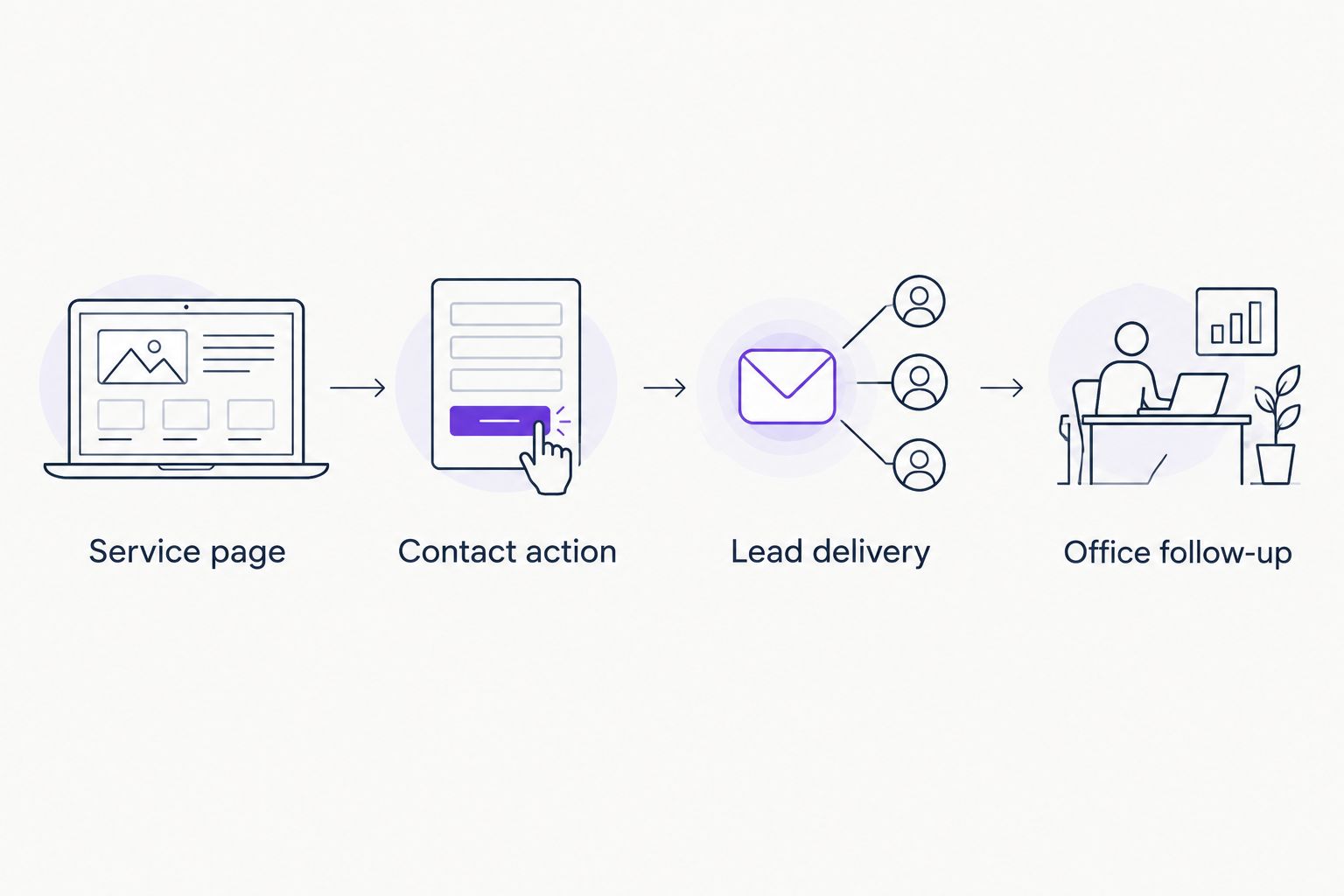
Test that path before launch. Submit an agreed test inquiry, confirm receipt, and check the message the customer sees afterward. A form that displays a success message still needs a verified destination.
Distinguish a booking request from a confirmed appointment. Your website wording should match your scheduling process. If someone must call the customer back, say so instead of promising that the visit is booked.
Step 5: Get ownership and responsibilities in writing
Before you approve a 2026 proposal, ask who controls the domain, hosting account, website administration, and connected measurement accounts. Request the access arrangement and handover process in writing. Do not settle for a verbal promise that everything is handled.
Clarify what happens if you stop working together. Ask which content and design files you receive, which outside services remain necessary, and whether moving the site requires rebuilding any part of it.
Separate responsibilities clearly:
- Who supplies job photos and confirms permission to use them.
- Who writes and checks service descriptions.
- Who handles technical updates and broken forms.
- Who changes hours, service areas, and contact details.
- Who owns the task of reviewing inquiry data.
Responsibility needs a name, not an assumption. If both sides think the other person checks incoming forms, your agreement has a gap. Close it before work starts.
Step 6: Require testing and launch approval
Use 2 approval gates: approve the proposed design and content, then approve the tested website for publication. These are recommended project controls, not a reason to rush your review. The live site stays unchanged until you authorize the agreed work.
Ask the company to show a preview where you can review pages, phone numbers, forms, and mobile layouts. Check the details yourself. You know whether the service area, equipment photos, and job descriptions match your business.
Before launch, require a plan for existing URLs. If a page address changes, ask which redirect will send visitors from the old address to the relevant replacement. Also confirm who checks the site immediately after publication and handles problems.
Treat launch as a handoff, not a mystery. Your 2026 project agreement should identify the final approver, publication responsibility, and post-launch support included in the scope.
Discuss your plumbing website project
Explain your services, service area, and website needs before agreeing to a project scope.
Why plumbing website project scopes vary
Different proposals are not directly comparable until they describe the same work. Ask candidates to explain these scope drivers rather than giving you a single unexplained package:
- Content responsibility: Editing existing text differs from researching and writing new service pages.
- Website condition: Repairing a specific issue differs from replacing the underlying structure.
- Lead handling: A contact form differs from a scheduling workflow with assigned follow-up.
- Branding work: Keeping an existing identity differs from developing new logo and branding materials.
- Ongoing responsibility: Launch-only work differs from an agreement that includes later updates and maintenance.
Write these distinctions into your comparison sheet. A proposal that excludes content or support is not equivalent to one that includes those tasks. Choose the scope your business needs, not the longest feature list.
Should I hire a local website designer for my plumbing company?
Choose based on demonstrated understanding and a workable communication process, not location alone. A local meeting does not replace a clear scope, and a remote presentation does not excuse vague answers.
For a plumbing business in Omaha, Kansas City, Des Moines, Denver, or Chicago, ask the candidate to explain how the website will describe your actual service boundaries. City names alone do not tell homeowners whether you will visit their address.
Can a new plumbing website guarantee more booked jobs?
No. Website design cannot guarantee booked jobs because a booking also depends on customer demand, the work you accept, and your response process. Reject promises that skip those conditions.
Agree on what you will measure instead. Distinguish contact-button clicks, received inquiries, qualified requests, and booked work; they describe different stages, not interchangeable results.
What should I ask on the first agency call?
Ask who writes the content, how inquiries reach your team, what you own, and who approves publication. Then ask the candidate to demonstrate a relevant working website.
Bring your current site and a short list of problems. A useful conversation connects the proposed work to those problems instead of immediately changing the subject to fonts and colors.
FAQ
What’s the best way to compare plumbing website design companies?
Give each company the same brief and compare the written scope. Check content responsibility, lead delivery, ownership, testing, and launch approval before judging the visual proposal.
Does a plumbing website designer need plumbing experience?
Relevant plumbing experience helps you assess fit, but it does not replace a working demonstration. Ask the designer to explain your services accurately and show how customers will contact your business.
Should I choose a website redesign or just fix my current site?
Choose targeted repairs when the existing site works and the problems are specific. Consider a redesign when its structure or content no longer matches your business, after asking the designer to explain what cannot be fixed directly.
Will Moore Media Collective handle branding as well as website design?
Moore Media Collective lists branding, logo design, website design, and social media management among its services for trades businesses. Confirm which services are included in your written proposal rather than assuming they come together.
Should I keep control of my plumbing company’s domain?
Require documented control and access arrangements for your domain. Confirm who manages renewal, which account holds it, and how access transfers if the working relationship ends.
Can a designer publish my new plumbing website without asking me?
Make explicit launch approval a written project requirement. Review the preview, verify the contact details, and approve publication only after the agreed tests are complete.
What should I measure after my plumbing website launches?
Measure received inquiries and booked work alongside website contact actions. A button click does not establish that your team received a request or that a customer scheduled a job.
One last thing
Before signing your 2026 website agreement, ask the designer to walk through one ordinary customer inquiry from page visit to office response. Then ask who is responsible at every handoff.
If nobody can explain where the inquiry lands, the project is not ready to start. Settle that question before debating the homepage photo.