
A roofing website needs a scope-based quote in 2026; a headline figure does not tell you what you will actually receive. Separate the website build from ongoing hosting, maintenance, content, and lead-handling work before you compare proposals.
- How much does a roofing website cost? Compare written scope, ownership, and ongoing responsibilities before choosing a quote.
- Moore Media Collective fits trade owners seeking website design and branding services, not a roofing software product.
- A roofing website should explain your services, show real project proof, and make contacting your business straightforward.
- Keep website construction, ongoing support, and local SEO separate in your proposal comparison.
How much does a roofing website cost in 2026?
The useful answer is the total commitment for an agreed scope, not an isolated build figure. Ask each provider to quote the same pages, content responsibilities, functionality, and launch requirements. Otherwise, you are comparing different jobs.
Think of it like roofing estimates. A proposal that describes materials, preparation, and cleanup tells you more than a total with no explanation. Your website proposal needs the same clarity.
Start with the work you need. A website design and branding services discussion should establish the deliverables before it turns into a design conversation.
Use this breakdown to make each proposal readable:
| Work category | What to have specified | What to clarify separately |
|---|---|---|
| Planning | Goals, audience, page list, and navigation | Who approves the scope |
| Website design | Page layouts and mobile layouts | Which pages receive distinct designs |
| Website build | Working pages, forms, and navigation | Connections to outside systems |
| Content | Writing, editing, and image preparation | Who supplies project details and photos |
| Launch | Testing, domain connection, and publication | Who authorizes the live changes |
| Ongoing operation | Hosting, updates, backups, and support responsibilities | What continues after launch |
| Search work | Defined setup or ongoing SEO tasks | What is included beyond website construction |
Do not assume a row is included because a proposal says “complete website.” Get the deliverables written down. That is how you stop a vague estimate from becoming an argument later.
Why this matters
You want more useful calls, not a website project that consumes your evenings. A clear scope keeps the work tied to that goal: explain what you do, establish local credibility, and make the next step obvious.
A roofing company in Des Moines needs to show where it works and which roofing jobs it accepts. An Omaha HVAC contractor or Kansas City plumber faces the same basic task. Different trade, same question from the customer: can this business handle my job?
A polished website cannot promise booked jobs. Your service offering, local visibility, response process, and sales follow-up still matter. Judge the website on the work it is supposed to do, then measure what happens after people contact you.
A focused roofing website: best for a clear service offering
A focused website suits a roofing business that needs to replace an outdated site and explain a straightforward set of services. Keep the structure tied to real customer decisions. Do not add pages just to make the project look substantial.
Useful content includes the roofing services you actually perform, your service area, company information, project examples, and a clear contact route. Separate services when they require different explanations. Do not imply you offer commercial roofing, emergency response, or insurance assistance unless you do.
The advantage is a tighter brief. Fewer distinct requirements give you fewer moving parts to approve and maintain. The limitation is coverage: an overly compressed site leaves little room to explain genuinely different jobs or answer detailed questions.
For example, roof repairs and full replacements need different explanations. A homeowner deciding whether to request an inspection needs useful context, not identical paragraphs with the service name swapped.
Keep the scope focused, but do not remove information customers need to choose you.
A broader roofing website: best for distinct services and markets
A broader website suits a roofing company with services or customer groups that need separate explanations. Residential repairs, commercial projects, and roof replacement are examples only if those services belong to your business.
More pages create more content and approval work. Each page needs a purpose, accurate details, and a clear next step. A longer navigation menu is not a business outcome.
The advantage is room for specific answers. The limitation is upkeep: every service claim, project example, and location reference needs to remain accurate. Publishing pages you cannot maintain creates another chore for your team.
For a company serving several cities, explain genuine differences where they exist. Do not manufacture a local office, completed project, or neighborhood connection to fill a page. A truthful service-area statement beats invented local detail.
| Website approach | Best for | Main advantage | Main limitation |
|---|---|---|---|
| Focused website | A clear, limited service offering | Easier to keep the message direct | Less space for distinct service explanations |
| Broader website | Different services or customer groups | More room for specific customer questions | More content to review and maintain |
| Connected website | A defined lead-routing process | Can connect inquiries to the next operational step | Requires connection testing and clear responsibilities |
A connected roofing website: best for a defined lead process
A connected website includes work beyond displaying information. Examples include sending form submissions into your customer-management system or directing different inquiries to different people. Request only connections that solve an actual operational problem.
Start with the handoff. Who receives a repair inquiry? What happens when someone requests work outside your service area? Where does the submission appear if an email notification fails?
The advantage is a defined route from inquiry to follow-up. The limitation is dependency: a working form does not prove every connected service is working. Access, configuration, testing, and ongoing responsibility need to be assigned.
Do not buy complexity because a demonstration looks impressive. If your office already handles inquiries reliably, a clear contact form and a working phone link deserve attention before a complicated routing setup.
Why roofing website quotes vary
The work behind the pages changes the quote. For your 2026 project, have each provider address these scope drivers explicitly:
- Page requirements. A page using an approved layout is different work from a page requiring its own structure, writing, and functionality.
- Content responsibility. Supplying finished copy and usable photos creates a different assignment from asking a provider to develop both.
- Design requirements. Adapting an existing layout differs from creating layouts around your specific services and proof.
- Connections. Forms, scheduling, customer-management systems, and other outside services introduce configuration and testing requirements.
- Existing-site changes. Replacing an established website calls for attention to existing addresses, content, and domain access.
- Post-launch responsibilities. Updates, backups, troubleshooting, and content changes need an owner after publication.
These are scope questions, not reasons to accept an unexplained quote. Ask what work each item includes and what triggers a change to the agreement.
How do you compare roofing website proposals fairly?
Give every provider the same brief. You do not need a technical document; you need clear decisions about what the website must do and who will supply the information.
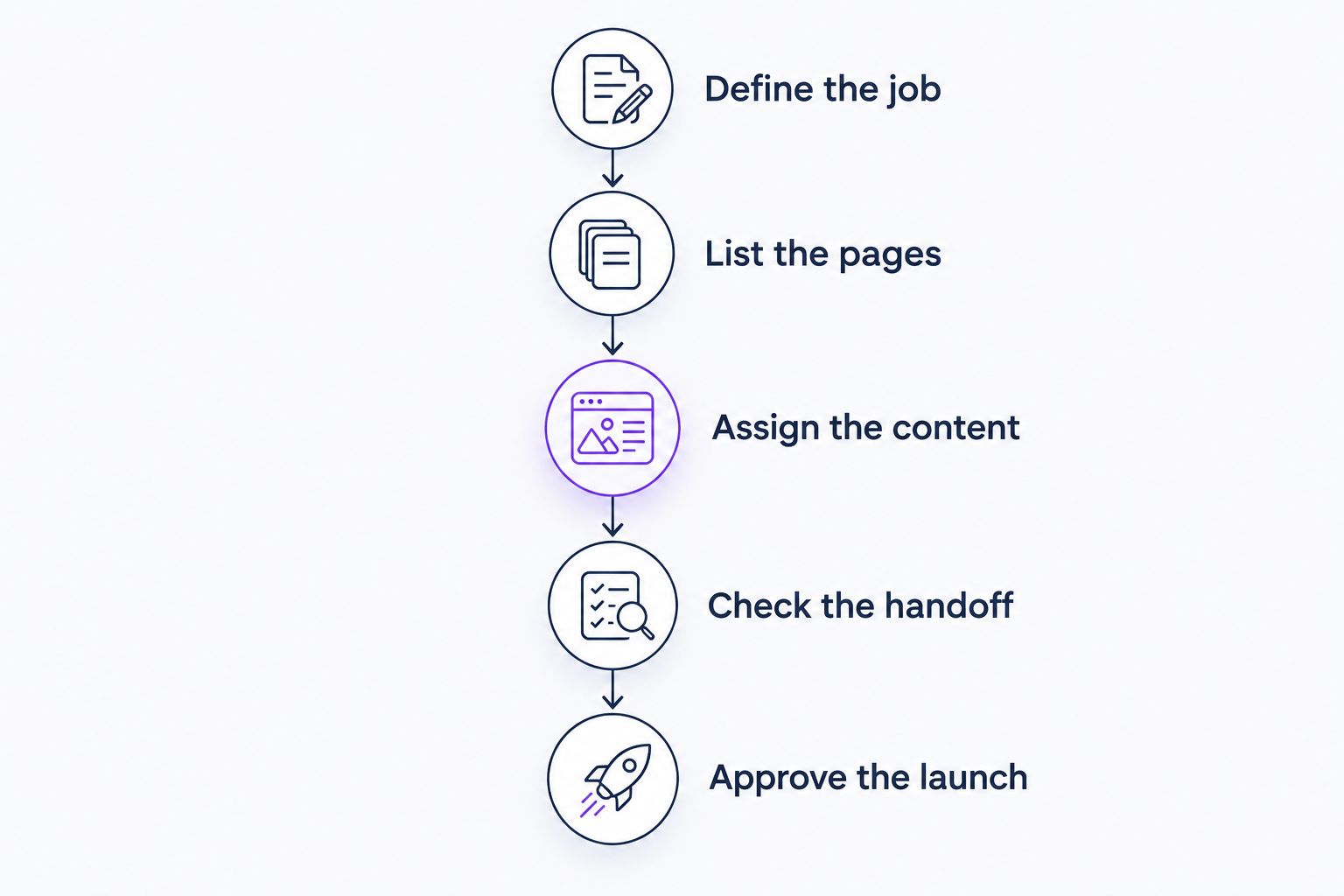
- Define the job. List your actual services, service area, and preferred customer action. Choose whether the main action is calling or submitting an inquiry.
- List the pages. Identify which pages need distinct content. Mark existing pages you intend to keep, replace, or remove.
- Assign the content. Name the person responsible for copy, project photographs, company details, and final fact-checking.
- Check the handoff. Describe where inquiries should arrive and who will test the full contact process.
- Approve the launch. Require a review of the finished work and explicit permission before live changes happen.
Send that brief with every request for a proposal. When replies arrive, compare the written commitments against the brief rather than judging the presentation alone.
Ask providers to distinguish included work from optional work. If a proposal mentions SEO, request the actual tasks. If it mentions support, ask who handles which problems and how you request help.
Keep approval authority with your business. Put that requirement in writing rather than assuming everyone shares the same definition of “ready to launch.”
What should you check before signing a website agreement?
Start with ownership and access. Confirm who controls the domain, website account, content, and connected services. Ask what you receive if the working relationship ends.
Next, check the revision process. Find out when you review the layout, when you review the content, and how changes outside the agreed scope are handled. A vague promise of flexibility is not a substitute for clear responsibilities.
Ask for a launch checklist covering mobile navigation, phone links, form delivery, and existing website addresses. If addresses change, identify which old pages need to send visitors to relevant replacements. Do not assume that work happens automatically.
For a 2026 website agreement, make the ongoing arrangement just as clear as the build. Identify the hosting responsibility, support contact, and process for requesting content changes. Keep any ongoing marketing agreement distinct from basic website operation.
Moore Media Collective fits trade owners who need website design and branding services. That service fit does not replace a written scope; confirm the actual deliverables, responsibilities, and approval process before committing.
Define your roofing website project
Describe your services, current website problems, and the customer action you want to improve.
Is a website redesign enough to get more roofing leads?
A website redesign addresses the website, not every part of customer acquisition. You still need people to find the business and someone to handle inquiries when they arrive.
Keep the website brief connected to those realities. Show the work you perform, use accurate project evidence, and make the contact route clear. Then check whether submitted inquiries reach the right person.
Do not accept guaranteed rankings or booked jobs as a replacement for defined deliverables. Design, search visibility, and sales follow-up are connected, but they are not the same service.
Should you keep your current roofing website platform?
Keep your current platform in consideration if it supports the work you need and your business can access it. An outdated appearance alone does not establish that a full platform change is necessary.
Ask the provider to explain any proposed move in plain language. What problem does it solve? What content moves, what needs rebuilding, and what happens to existing page addresses?
A platform decision also affects maintenance responsibilities. Choose an arrangement your business can manage, not one that leaves ownership and routine changes unclear.
FAQ
How much does a roofing website cost in 2026?
A roofing website needs a quote tied to its pages, content, design, connections, and ongoing responsibilities. Compare the same written scope across providers rather than treating a headline figure as the full commitment.
What should a roofing website proposal include?
A roofing website proposal should identify deliverables, content responsibilities, review stages, launch approval, and post-launch responsibilities. It should also explain how work outside the agreed scope is handled.
Do I need separate pages for every roofing service?
Use separate pages when the services need distinct explanations. Do not add pages for work your business does not perform or duplicate the same explanation under different headings.
Is SEO included with roofing website design?
Treat SEO as included only when the agreement names the specific tasks. Website construction and ongoing search work should have clear, separate deliverables.
Can I use my own roofing project photos?
Use your own project photos when you have the necessary rights and permissions. Tell the provider what images you can supply and who will confirm that captions describe the work accurately.
Who should approve changes to my live roofing website?
Your business should approve changes before they reach the live website. Put the approval requirement and authorized decision-maker in the agreement.
Does Moore Media Collective work with roofing businesses?
Moore Media Collective provides websites, logo design, branding, and social media management for roofing and other trade companies. Confirm the scope of your particular project directly before making a commitment.
One last thing
Before you request a 2026 redesign, submit an inquiry through your current website yourself. Use a phone, complete the form, and follow the submission to the person responsible for responding. A form that looks finished is not proof that the handoff works.
Bring that result to your website discussion. Moore Media Collective offers website design and branding for trades; your brief should connect that work to a specific business need. Fix the path from interested homeowner to real conversation before adding decoration.